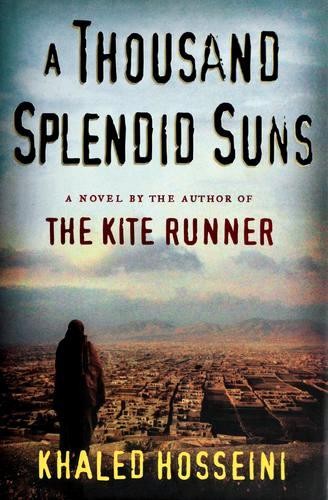
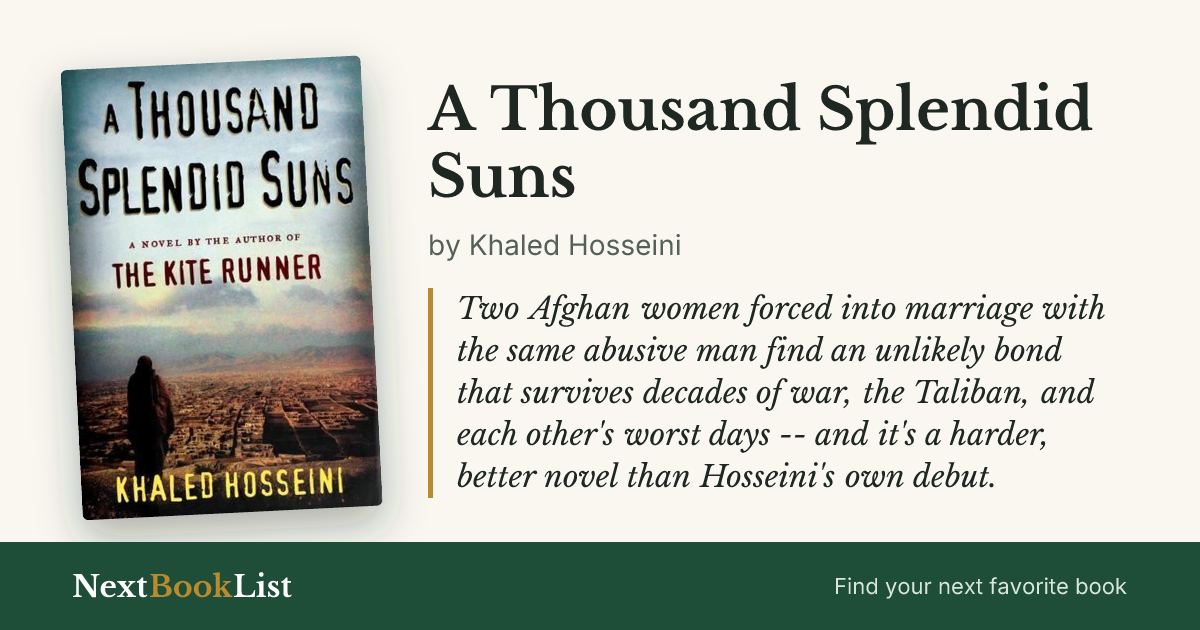
A Thousand Splendid Suns
by Khaled Hosseini · 2007
Two Afghan women forced into marriage with the same abusive man find an unlikely bond that survives decades of war, the Taliban, and each other's worst days -- and it's a harder, better novel than Hosseini's own debut.
Worth reading? A Thousand Splendid Suns is the better novel of Hosseini's first two, mostly because Mariam and Laila carry more weight than Amir ever did -- their bond isn't built on guilt, it's built on shared survival, and that gives the book a warmth The Kite Runner never quite earns. It's also considerably bleaker about what the Taliban years actually did to women's daily lives, and it doesn't soften that for the reader.
| Author | Khaled Hosseini |
|---|---|
| Published | 2007 |
| Publisher | Riverhead Books |
| Category | Fiction |
| Favorite quote | “Like a compass needle that points north, a man's accusing finger always finds a woman.” |
The Verdict
Mariam is the reason this book outlasts Hosseini’s debut. Her half of the novel, decades of a marriage nobody would choose, carries none of the guilt-driven plotting The Kite Runner leaned on, just the slow accumulation of a life lived under someone else’s control. That’s harder to write and Hosseini pulls it off.
The Taliban sections are specific in a way a lot of fiction about the regime isn’t – school closures, burqa enforcement, public punishments – Hosseini uses Laila’s daily restrictions to make the politics concrete instead of abstract. You feel the walls closing in scene by scene rather than being told about them.
Read it if you want a war novel centered on women’s survival that doesn’t flinch from how bad the abuse gets. Skip it if you need a lighter read – this one sustains its darkest material for most of the book before the ending offers any real relief.
you want a novel centered on women's survival under an abusive marriage and an oppressive regime, told with real specificity about what daily life under the Taliban actually restricted
you found The Kite Runner's emotional directness manipulative -- this book uses the same tools even more aggressively, so if that style didn't work for you once it won't work better here
Book Summary
Mariam, an illegitimate daughter married off at fifteen to an abusive shoemaker in Kabul, spends decades trapped in that marriage before a much younger second wife, Laila, is forced into the same household after losing her family to a rocket attack.
The two women's relationship moves from open hostility to a fierce protective bond, and Hosseini uses their shared domestic imprisonment to show how the Taliban's restrictions on women (school closures, mobility bans, forced burqas) layered on top of an already-abusive marriage to compound the danger both women faced.
The novel spans roughly four decades of Afghan history, from the monarchy through the Soviet occupation, civil war, and Taliban rule, using Mariam's and Laila's changing circumstances as a ground-level lens on each political shift.
Mariam's final act -- a violent intervention to protect Laila, followed by her own execution -- reframes the entire novel around female solidarity and self-sacrifice rather than romantic love, which is the book's clearest departure from a conventional domestic drama.
Top 7 Lessons from A Thousand Splendid Suns
- The novel treats domestic abuse and political oppression as compounding forces, not separate plotlines -- Rasheed's violence at home and the Taliban's restrictions outside the home reinforce each other.
- Mariam's arc as an unwanted, illegitimate daughter shows how the book roots individual suffering in specific social structures (stigma around illegitimacy, forced marriage) rather than treating it as generic misfortune.
- The bond between Mariam and Laila argues that solidarity between women under shared oppression can matter more than blood family -- Mariam ultimately sacrifices herself for a woman she wasn't related to.
- Laila's decision to return to Kabul after the Taliban's fall, rather than stay safely in Pakistan, frames rebuilding a broken country as a real moral choice, not just a plot convenience.
- The book uses education, Laila's schooling before the war, its loss under the Taliban, its restoration after, as a recurring measure of how much freedom women in the story actually have at any given point.
- Rasheed is written as a product of a culture that gives him near-total license over his wives, not just as an individually cruel man -- the book is careful to indict the structure, not just the person.
- Roughly four decades of Afghan political history -- monarchy, Soviet occupation, civil war, Taliban rule -- reach the reader entirely through their effect on Mariam's and Laila's domestic lives, not through outside political narration.
Top 2 Quotes from A Thousand Splendid Suns
"Like a compass needle that points north, a man's accusing finger always finds a woman."
Khaled Hosseini, A Thousand Splendid Suns
"Marriage can wait, education cannot."
Khaled Hosseini, A Thousand Splendid Suns
Frequently Asked Questions
Is A Thousand Splendid Suns worth reading?
Yes -- it's a stronger, more emotionally grounded novel than The Kite Runner, with two of the more memorable female protagonists in recent literary fiction.
What is A Thousand Splendid Suns about?
Two Afghan women, forced into marriage with the same abusive man, who form a protective bond that carries them through decades of war and Taliban rule.
Is A Thousand Splendid Suns sadder than The Kite Runner?
Most readers find it harder to read -- it depicts sustained domestic abuse and the specific restrictions Taliban rule placed on women's daily lives.
Do I need to read The Kite Runner first?
No, the books share no characters or plot -- only the Afghan setting connects them.
Is A Thousand Splendid Suns based on real events?
It's fiction, but it's grounded in the real political history of Afghanistan from the 1970s through the early 2000s.
Ready to read it?
Get A Thousand Splendid Suns on Amazon