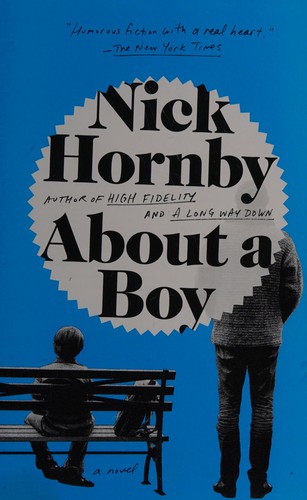
About a Boy
by Nick Hornby · 1998
A wealthy, aimless bachelor who invents a fake son to meet single mothers accidentally befriends a genuinely lonely twelve-year-old, and the two of them end up parenting each other into something closer to maturity.
Worth reading? About a Boy takes a fairly cynical premise -- a man fakes a kid to pick up single mothers -- and turns it into a genuine, unsentimental study of two people, one thirty-six and one twelve, both stuck at the wrong emotional age for their years.
| Author | Nick Hornby |
|---|---|
| Published | 1998 |
| Publisher | Riverhead Books |
| Category | Fiction |
The Verdict
The dual narration is doing more work than it gets credit for. Will’s chapters are all deflection and cool detachment; Marcus’s are painfully direct. Reading them side by side is what makes the eventual friendship feel earned instead of convenient.
Hornby also doesn’t let Will off easy for how the friendship starts. The fake-son scheme stays a genuinely selfish, slightly pathetic plan even after real affection develops, and that honesty keeps the book from tipping into easy sentimentality.
Read it if you want a warm, funny novel about an unlikely friendship that doesn’t pretend either character starts out mature. Skip it if you need more plot than two people slowly becoming important to each other.
you want a funny, warm novel about unconventional found family that doesn't pretend adulthood or childhood are simple to get right
you want a plot-heavy story -- this is a character study built on two parallel voices (Will's and Marcus's), and if you need more incident, it can read as slight
Book Summary
Will Freeman, living comfortably off song royalties from his late father and completely uncommitted to work, relationships, or growing up, invents a fictional son to join a single parents' support group, purely to meet women. There he meets Marcus, a genuinely odd, friendless twelve-year-old whose mother struggles with depression and whose survival strategies at school are actively making his life worse.
Hornby alternates narration between Will and Marcus, letting their voices develop in counterpoint: Will is fluent in cool, ironic detachment and has nothing underneath it, while Marcus is painfully sincere and completely unable to read the social codes that would protect him from being bullied. Their unlikely friendship starts as convenience and becomes real need on both sides.
The novel resists an easy 'man learns to be a father figure' arc. Will doesn't become Marcus's parent so much as Marcus's first real friend, and the growth runs in both directions -- Marcus needs to learn some of Will's social fluency to survive, and Will needs to develop some of Marcus's sincerity to actually connect with anyone.
Top 9 Lessons from About a Boy
- Will's fake son is initially just a dating strategy, and the novel is honest about how cynical that starting point is rather than softening it retroactively.
- Marcus's social isolation at school comes from genuine difference (his taste, his mother's depression, his sincerity) rather than a generic 'bullied kid' setup, giving his storyline real specificity.
- The dual narration -- Will's ironic detachment against Marcus's earnestness -- is the book's structural backbone, letting each character's blind spots show through contrast with the other.
- Will's growth isn't framed as him becoming a father figure; it's framed as him learning to actually need another person, which the novel treats as harder for him than any parenting skill would be.
- Marcus's mother's depression and a suicide attempt are treated seriously and without cheap resolution, grounding the novel's comedy in real stakes.
- The found-family ending doesn't erase the earlier cynicism of Will's motives -- the book lets both things be true: he started for bad reasons and ended up in a real relationship anyway.
- Will opens the novel treating 'no man is an island' as a mistake to correct in his own life -- he's built himself into a self-sufficient one-man unit -- and the whole plot is structured as proof that this doesn't actually work.
- Marcus's earnest, unfashionable tastes inherited from his mother's hippie sensibility make him an easy target at school, and Will's cynically superficial fixes -- better trainers, a decent haircut -- solve the surface problem without touching what actually isolates Marcus.
- The novel ties Marcus's precocious worry about his mother directly to his social awkwardness, making clear that what reads as 'weirdness' at school is really a twelve-year-old carrying an adult's problem alone.
Frequently Asked Questions
Is About a Boy worth reading?
Yes -- it's a funny, warm character study that earns its found-family ending without oversimplifying either character's growth.
Is the movie a good adaptation?
The 2002 film with Hugh Grant is a well-regarded, fairly faithful adaptation, though it softens some of the book's darker material around Marcus's mother.
Is this book appropriate for younger readers?
It's written for adults -- depression, a suicide attempt, and adult relationships are handled with more weight than a YA treatment would give them.
Is Will a sympathetic character?
Not at first -- his motives for joining the single parents' group are genuinely selfish, and the novel is upfront about that before letting him grow.
Does the book have a TV adaptation too?
Yes -- an NBC sitcom adaptation aired in 2014-2015, relocating the story to San Francisco.
Ready to read it?
Get About a Boy on Amazon