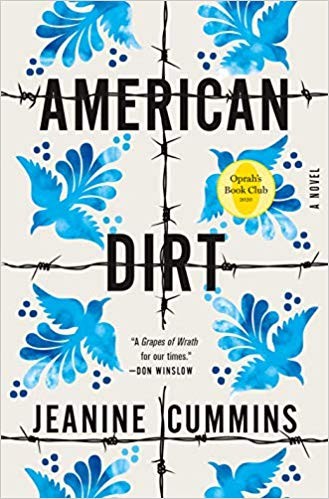
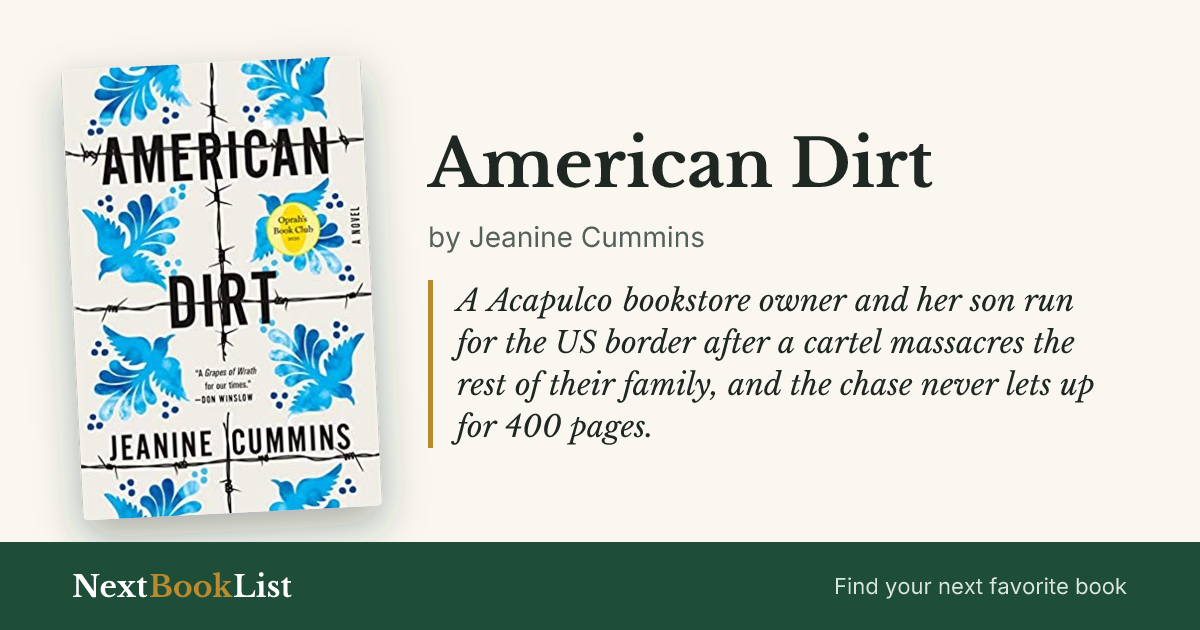
American Dirt
by Jeanine Cummins · 2020
A Acapulco bookstore owner and her son run for the US border after a cartel massacres the rest of their family, and the chase never lets up for 400 pages.
Worth reading? American Dirt is a page-turner first and a migration novel second, and that ordering is exactly what made it controversial. Cummins writes propulsion better than nuance -- you will read this in two sittings -- but the controversy over an outsider author profiting from a trauma narrative she didn't live is a real conversation, not manufactured outrage, and it's worth knowing before you pick this up.
| Author | Jeanine Cummins |
|---|---|
| Published | 2020 |
| Publisher | Flatiron Books |
| Category | Fiction |
The Verdict
Cummins writes chase scenes better than she writes anything else in this book, and that’s not an insult. Once Lydia and Luca get on La Bestia, the pages turn themselves. You stop noticing the prose and start just needing to know if they make it to the next stop alive.
The controversy is worth taking seriously rather than dismissing as noise. The core criticism, that a comfortable outsider got paid millions to write a trauma story that flattens a community’s lived reality into thriller mechanics, isn’t a hot take. It’s a real question about who publishing rewards to tell which stories.
Read it if you want a fast, tense read and you can hold the book and its context in your head at the same time. Skip it if you’d rather read migration fiction from writers who lived it, or if knowing the backstory will keep pulling you out of the book.
you want a propulsive, plot-driven thriller about migration that reads fast and doesn't let you put it down, and you're fine separating the reading experience from the loud debate around who gets to tell this story
you want an #ownvoices account of the migrant journey written from lived experience, or you're allergic to books that got more attention for their controversy than their prose
Book Summary
Lydia, a middle-class bookstore owner in Acapulco, watches a cartel gun down sixteen members of her family at a birthday party because her husband, a journalist, wrote a profile of the cartel's boss. She and her eight-year-old son Luca become undocumented migrants overnight, riding La Bestia north with nothing but the money in her jeans and a target on her back.
The novel's engine is pure thriller mechanics: a pursuing killer, a series of near-misses, a cast of fellow migrants who each carry their own reason for running. Cummins keeps the pace relentless, which is the book's biggest strength and also the source of the backlash -- critics argued the migrant experience got flattened into a page-turner's plot beats rather than treated as the sustained, grinding reality it is for millions of people.
The controversy that followed publication (a non-Mexican, non-migrant author writing this story, a seven-figure advance, a launch event with barbed-wire centerpieces) became a bigger story than the book itself, and it's fair to read American Dirt with that context rather than pretending it doesn't exist.
Top 9 Lessons from American Dirt
- The novel treats the US-Mexico border crossing as a life-or-death gauntlet, not a bureaucratic process, which is accurate for migrants fleeing violence but different from the economic-migration story more common in reality.
- La Bestia, the freight train migrants ride north through Mexico, is rendered as a genuine character in the book, dangerous and unpredictable, and Cummins researched its real routes and hazards.
- The story deliberately strips its protagonist of the poverty most migrants flee to make her more legible to a comfortable reader -- Lydia starts middle-class, which was one of the loudest points of criticism against the book.
- Cartel violence in the novel functions less as social commentary and more as the inciting incident for a chase plot, which is a legitimate storytelling choice but not the same as journalism or memoir.
- The book's popularity (an Oprah's Book Club pick) exposed a real gap between what publishing rewards and who gets to write trauma narratives about communities they don't belong to.
- Secondary migrant characters exist mostly to advance Lydia and Luca's journey rather than carry full arcs of their own, a structural choice that drew criticism for using migration as backdrop rather than subject.
- The cartel boss Javier is introduced earlier in the book as a friendly, literary-minded regular at Lydia's shop, so the massacre lands as a betrayal by someone she trusted rather than violence from a stranger -- raising the personal stakes above a generic cartel-thriller villain.
- The sisters Soledad and Rebeca, traveling separately from Lydia and Luca, are used to depict the sexual violence migrant women specifically face on the journey north, widening the novel's lens beyond its two central protagonists.
- Luca's precociousness -- his fixation on geography and place names -- functions as a coping mechanism for a child processing trauma, giving the book a child's-eye register alongside Lydia's adult terror.
Frequently Asked Questions
Is American Dirt worth reading?
As a thriller, yes -- it moves fast and doesn't let up. Go in aware of the well-documented controversy over an outsider author writing this specific story.
What is American Dirt about?
A bookstore owner and her young son flee Acapulco after a cartel murders their family, riding freight trains north to cross into the United States.
Why was American Dirt controversial?
Critics, many Mexican and Latino writers among them, argued a non-migrant author profited from a trauma narrative that flattened the real migrant experience into thriller plot beats, and pointed to a seven-figure advance and tone-deaf launch marketing.
Is American Dirt based on a true story?
No -- it's fiction, though Cummins researched migration routes, cartel violence, and border-crossing conditions.
Was American Dirt an Oprah's Book Club pick?
Yes, which amplified both its sales and the backlash against it.
Ready to read it?
Get American Dirt on Amazon