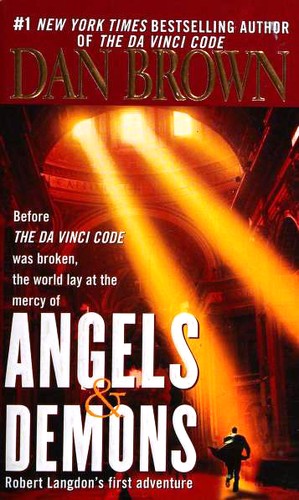
Angels and Demons
by Dan Brown · 2000
A Harvard symbologist gets pulled into Vatican City after a canister of antimatter stolen from CERN turns up hidden somewhere inside, with a countdown clock and a centuries-old secret society behind it.
Worth reading? Angels and Demons is a functional, fast-moving thriller and, frankly, a tighter book than The Da Vinci Code that came after it and made Brown a household name. The puzzle-box structure (symbol, clue, location, repeat) is formulaic but effective, and Brown knows exactly how to end a chapter to make you keep reading.
| Author | Dan Brown |
|---|---|
| Published | 2000 |
| Publisher | Pocket Books |
| Category | Fiction |
The Verdict
The puzzle-box structure is the whole appeal, and Brown is genuinely good at it: each clue leads fast enough to the next that you don’t have time to notice how thin the prose is underneath.
The science-versus-religion framing gets marketed as the book’s big idea, but it’s mostly set dressing – the antimatter bomb is a ticking-clock device, not a real inquiry into faith and physics. Don’t come to this book for that.
Where it earns real credit is the ending: the conspiracy running through the Church’s own power structure rather than a cartoon outside villain is a sharper choice than the setup suggests you’re going to get.
Read it if you want a fast, well-paced puzzle thriller and don’t need the science or history to hold up. Skip it if inaccuracies dressed up as fact bother you more than the pacing can make up for.
you want a fast, gimmick-driven thriller with puzzle-solving set pieces and short chapters built for binge reading -- this is the book that established Brown's formula before The Da Vinci Code made it a phenomenon
you care about scientific or historical accuracy holding up to scrutiny -- the antimatter physics and Illuminati history are both closer to dramatic license than fact, and Brown's prose style draws real criticism
Book Summary
Robert Langdon, a Harvard symbologist, is called to CERN after a physicist is murdered and a vial of antimatter, capable of an enormous explosion, goes missing. The trail leads to Vatican City, where the Illuminati -- a secret society Langdon believes disbanded centuries ago -- appears to be resurfacing to take revenge on the Catholic Church during a papal conclave.
The plot structures itself as a series of puzzles: ambigrams, Renaissance art clues, and hidden markers scattered across Rome that Langdon has to decode under a ticking clock, each one leading to the next kidnapped cardinal before the antimatter detonates.
Brown pairs the science-versus-religion tension (a literal antimatter bomb built by physicists threatening the Vatican) with a conspiracy inside the Church itself, and the eventual reveal implicates someone within Vatican power structures rather than an external villain alone, which is the novel's most effective twist.
Top 9 Lessons from Angels and Demons
- The novel's puzzle-box pacing (each clue leads directly and quickly to the next) is the format's real innovation, built for the reader to keep flipping pages rather than for literary depth.
- Brown uses real institutions (CERN, the Vatican) and real art history as scaffolding, then takes significant dramatic license with both the physics and the history built on top of them.
- The science-versus-religion framing is more marketing hook than genuine philosophical inquiry -- the book resolves it through plot rather than argument.
- The eventual reveal that the conspiracy runs through the Church's own power structure, not an external enemy, is the novel's sharpest structural choice.
- Short chapters, each ending on a cliffhanger, are a deliberate pacing mechanism that Brown would repeat across his later Langdon novels.
- The antimatter premise is scientifically implausible as depicted, and the book should be read as thriller convenience rather than hard science fiction.
- Vittoria Vetra, the CERN physicist who co-created the antimatter, works the case alongside Langdon as an equal rather than a damsel, giving the novel a science-versus-symbology detective pairing instead of one expert carrying the whole plot.
- The 'Path of Illumination,' a hidden trail of sculpted altars scattered across Rome marking real Bernini works, is the novel's central puzzle mechanism and the clearest example of Brown building fiction on top of genuine art history before bending it to the plot's needs.
- The book was written around real antimatter research happening at CERN in the late 1990s, giving its central MacGuffin a thin veneer of plausibility even though the physics of storing and detonating it as depicted isn't realistic.
Frequently Asked Questions
Is Angels and Demons worth reading?
Yes, as a fast puzzle-driven thriller -- it's arguably tighter than The Da Vinci Code, which came after and made Brown famous.
What is Angels and Demons about?
A Harvard symbologist races to find a stolen antimatter bomb hidden somewhere in Vatican City by a resurfacing Illuminati conspiracy during a papal conclave.
Do I need to read The Da Vinci Code first?
No, Angels and Demons was published first and works as a standalone introduction to the character Robert Langdon.
Is Angels and Demons scientifically accurate?
No -- the antimatter physics and much of the Illuminati history are dramatized well past factual accuracy.
How does the book compare to the 2009 film?
The film changes major plot elements, including who's behind the conspiracy, more significantly than most Brown adaptations.
Ready to read it?
Get Angels and Demons on Amazon