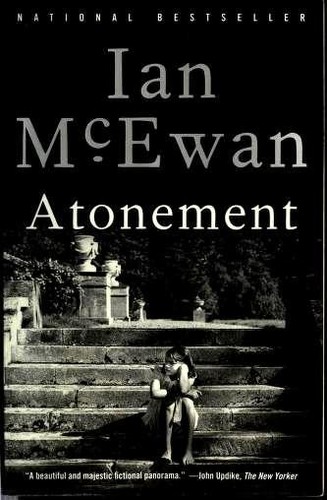
Atonement
by Ian McEwan · 2001
A thirteen-year-old's false accusation destroys two lives in a single summer afternoon, and McEwan spends the rest of the novel asking whether a lifetime of guilt -- or fiction itself -- can actually fix what she broke.
Worth reading? Atonement works because the crime at its center is so ordinary -- a child misreading an adult situation and insisting she's right -- and so devastating anyway. The war-set middle section, following Robbie's retreat to Dunkirk, is the best sustained writing in the book, and the final section's reveal about who's actually narrating recasts the entire novel without feeling like a cheap trick.
| Full Title | Atonement: A Novel |
|---|---|
| Author | Ian McEwan |
| Published | 2001 |
| Publisher | Anchor Books |
| Category | Fiction |
The Verdict
The first section, a single sweltering afternoon at the Tallis country house, is deliberately slow, and it needs to be – you have to feel exactly how small the misunderstanding is before you can feel how enormous its consequences become. McEwan doesn’t rush the crime because the crime isn’t really the point; the ripple is.
The Dunkirk section is where the writing is most alive, and it’s easy to forget you’re still reading the same story about a child’s accusation while you’re in the middle of a retreating army. That’s the design: war doesn’t erase the personal harm, it just gives it a bigger stage to play out on.
Read it if you want literary fiction where the final structural reveal genuinely changes your understanding of the book, not just a rug-pull for shock value. Skip it if you need the ending to resolve cleanly – McEwan’s entire argument is that some things don’t.
you want literary fiction with a genuine structural trick that changes how you read everything that came before it, not just a twist for its own sake
you want the ending to hand you closure -- McEwan's whole point is that some harm can't be undone, no matter how good the story you tell about it
Book Summary
In 1935, thirteen-year-old Briony Tallis witnesses a moment between her older sister Cecilia and Robbie Turner, the housekeeper's son, misreads it, and later falsely accuses Robbie of a crime he didn't commit -- a single act of a child's certainty that destroys Robbie's future and Cecilia's happiness.
The novel's middle section follows Robbie years later as a soldier retreating to Dunkirk, and McEwan uses the chaos of that retreat to show how one person's false accusation can ripple into a life permanently altered by war and imprisonment.
Briony spends her adult life as a novelist trying to atone for what she did as a child, and the book's final section reveals that the "happy ending" the reader has been given for Robbie and Cecilia is itself Briony's fictional invention -- the real outcome was worse, and no novel can actually fix it.
Top 7 Lessons from Atonement
- The entire plot turns on a thirteen-year-old's confident misreading of an adult situation -- the novel treats a child's certainty as more dangerous than a child's ignorance.
- Robbie's wrongful accusation and imprisonment cost him years of his life and directly shapes his path into the war, tying a domestic mistake to a much larger historical catastrophe.
- The Dunkirk retreat section functions as its own self-contained ordeal, showing how individual lives get swept into events entirely outside their control.
- Briony becomes a novelist specifically to try to atone for her childhood accusation, making the act of writing fiction itself part of the novel's subject, not just its form.
- The novel's final twist reveals that its own 'happy ending' was invented by Briony as a character, which forces you to reread everything that came before as her attempt at atonement rather than a factual account.
- McEwan uses shifting points of view across the same events to show how differently each character experiences and remembers the same afternoon.
- The book argues that some harm is permanent -- atonement, however sincere, doesn't guarantee forgiveness or repair.
Frequently Asked Questions
Is Atonement worth reading?
Yes -- it's a rare literary novel where the structural twist actually earns its weight, recasting everything you've read once you learn who's really telling the story.
What is Atonement about?
A thirteen-year-old's false accusation in 1935 England destroys the lives of her sister and the housekeeper's son, and the novel follows the consequences through World War II and the accuser's lifelong attempt to atone as a novelist.
Does Atonement have a twist ending?
Yes -- the final section reveals that the version of events you've read, including its resolution, is a novel written by Briony, not a factual account of what actually happened.
Is Atonement a war novel?
Partly -- its middle section is one of the strongest fictional accounts of the Dunkirk retreat, but the book is really about the accusation and its aftermath, not the war itself.
Was Atonement adapted into a movie?
Yes -- the 2007 film adaptation starred Keira Knightley and James McAvoy and was nominated for multiple Academy Awards.
Ready to read it?
Get Atonement on Amazon