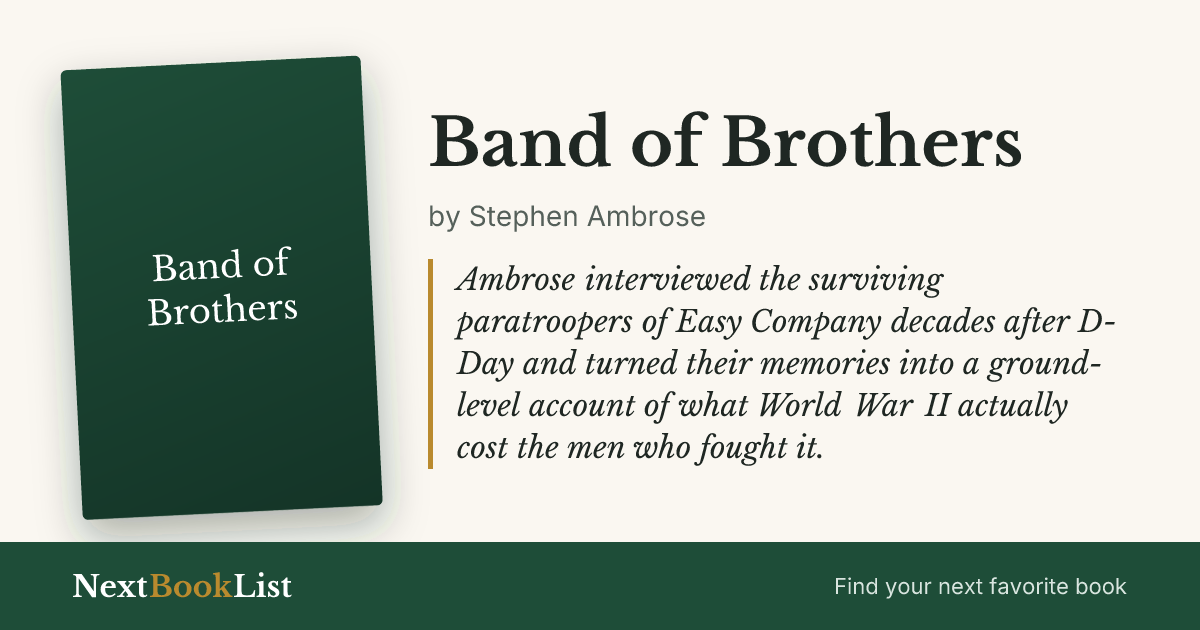
Band of Brothers
by Stephen Ambrose · 1992
Ambrose interviewed the surviving paratroopers of Easy Company decades after D-Day and turned their memories into a ground-level account of what World War II actually cost the men who fought it.
Worth reading? Band of Brothers works because Ambrose gets out of the way. The book is built almost entirely from interviews and letters from Easy Company's surviving veterans, and that firsthand material carries the book further than Ambrose's own prose does -- which is exactly the trade-off you want in a book like this.
| Full Title | Band of Brothers: E Company, 506th Regiment, 101st Airborne, from Normandy to Hitler's Eagle's Nest |
|---|---|
| Author | Stephen Ambrose |
| Published | 1992 |
| Publisher | Simon & Schuster |
| Category | History |
The Verdict
The strength of this book is how specific it gets. Ambrose names individual soldiers, tracks their fates across chapters, and lets their own recollections, sometimes contradicting each other, carry entire scenes. That’s rarer in military history than it should be.
Dick Winters emerges as the book’s clearest hero, not through any single dramatic speech but through a pattern of decisions under fire that the men around him kept independently praising decades later. The leadership lesson lands because it’s repeated by multiple witnesses, not asserted by the author.
Read it if you want a ground-level, firsthand-feeling account of what one company went through from Normandy to Germany. Skip it if you’re after strategic analysis of the broader war rather than one unit’s experience of it.
you want a vivid, soldier's-eye account of World War II combat in Europe, built from firsthand interviews with the men who were there
you want a strategic, big-picture military history -- this stays close to one company's experience and doesn't zoom out much
Book Summary
Ambrose tracks Easy Company, 506th Parachute Infantry Regiment, 101st Airborne Division, from their brutal training at Camp Toccoa through the D-Day jump into Normandy, the liberation of towns across France, the disastrous Operation Market Garden, the freezing siege at Bastogne during the Battle of the Bulge, and finally into Germany and Hitler's mountain retreat.
The book is built substantially from interviews Ambrose conducted with dozens of Easy Company veterans decades after the war, giving the narrative a firsthand texture, specific names, specific fears, specific small acts of courage and failure, that a purely archival military history couldn't reproduce.
A central thread is the company's relationship with Captain Richard Winters, whose leadership under fire, first at Brecourt Manor on D-Day and later throughout the campaign, becomes the book's model for effective, unglamorous battlefield command, in contrast to officers the men trusted less.
Top 7 Lessons from Band of Brothers
- Effective combat leadership in the book looks less like charisma and more like Dick Winters's consistent competence, calm decision-making, and willingness to share the men's risk and hardship.
- The brutal training at Camp Toccoa under a widely disliked commanding officer, while resented at the time, is credited by many veterans with the unit's later survival rate in combat.
- The siege at Bastogne during the Battle of the Bulge shows soldiers enduring extreme cold, inadequate supplies, and sustained bombardment with minimal support -- a very different picture of war than the liberation narrative that precedes it.
- Operation Market Garden's failure demonstrates how a flawed strategic plan can cost soldiers dearly regardless of their individual competence or courage on the ground.
- The book documents both battlefield heroism and its opposite -- moments of failure, fear, and poor leadership among some officers -- rather than presenting the company as uniformly heroic.
- Firsthand interviews conducted decades after the events show how differently individual veterans remembered and processed the same experiences, which Ambrose largely presents without resolving the discrepancies.
- The bond among Easy Company's surviving veterans, evident in how openly they spoke to Ambrose decades later, illustrates how shared combat trauma created lifelong connections that outlasted the war itself.
Frequently Asked Questions
Is Band of Brothers worth reading?
Yes -- it's one of the most widely read firsthand-style accounts of American WWII combat, later adapted into the HBO miniseries of the same name.
Is Band of Brothers a true story?
Yes -- it follows the real Easy Company, 506th Parachute Infantry Regiment, and is built from Ambrose's interviews with surviving veterans decades after the war.
Do I need to have seen the HBO series first?
No -- the book stands on its own and predates the series by nearly a decade, though many readers come to it after watching the show.
Does the book cover the whole war or just Europe?
Just the European theater, and specifically Easy Company's path from Normandy through Germany -- it doesn't cover the Pacific theater.
Ready to read it?
Get Band of Brothers on Amazon