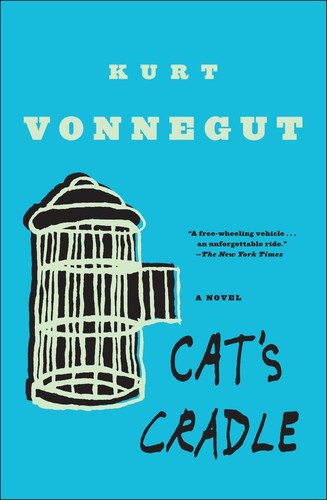
Cat's Cradle
by Kurt Vonnegut · 1963
A writer researching the atomic bomb stumbles into a fake religion, a made-up island nation, and a substance that can freeze all the water on Earth solid -- and Vonnegut uses the whole absurd setup to argue that the truths that actually help you live are the ones you know are lies.
Worth reading? Cat's Cradle is Vonnegut working at his sharpest, funniest, and bleakest simultaneously. Ice-nine, a substance that instantly freezes any liquid water it touches, is the science-fiction hook, but the real subject is Bokononism, a religion its own founder admits is entirely made up, and the novel's argument that useful lies might matter more than true things. It's short, fast, and structured in tiny numbered chapters that make it one of the more approachable entry points into Vonnegut's catalog.
| Author | Kurt Vonnegut |
|---|---|
| Published | 1963 |
| Publisher | Dial Press |
| Category | Fiction |
| Favorite quote | “Busy, busy, busy.” |
The Verdict
The ice-nine plot is the hook, but Bokononism is where the book actually lives, an entire invented religion built on the premise that its own founder tells you, in the first line of its holy book, that everything in it is a lie. That’s the joke and the argument at the same time, and Vonnegut never lets you settle on which one it is.
The short numbered chapters keep the pace quick, this is one of the fastest reads in Vonnegut’s catalog, but the ending doesn’t pull any punches for the brevity. It’s as bleak as anything he wrote, delivered with the same deadpan humor as everything before it.
Read it if you want Vonnegut’s satire at its tightest and want a fast, funny book that still lands a real punch. Skip it if you’re looking for a conventional science-fiction disaster story, ice-nine is a setup for satire, not the destination.
you want Vonnegut's sharpest satire, funny and genuinely bleak in the same sentence, aimed at science, religion, and nationalism all at once
you want a straight science-fiction disaster novel -- the ice-nine plot is really a delivery mechanism for satire, not the point of the book
Book Summary
John, the narrator, sets out to write a book about what American scientists were doing the day the atomic bomb dropped on Hiroshima, and his research leads him to the children of the bomb's fictional co-inventor, and eventually to the Caribbean island nation of San Lorenzo.
San Lorenzo is ruled by a dictator but spiritually governed by Bokononism, a religion openly founded on 'foma,' harmless untruths its own prophet Bokonon admits he invented, and the novel argues, through Bokononist scripture quoted throughout, that comforting lies can serve people better than uncomfortable truths.
Ice-nine, a weaponized form of water that freezes solid at room temperature and can chain-react with any liquid water it touches, exists in the story as a symbol of scientific progress pursued without any concern for consequence, and its eventual release turns the novel's satire literal and apocalyptic.
Top 7 Lessons from Cat's Cradle
- Ice-nine, a substance capable of instantly freezing all water on Earth, was developed by a scientist with no interest in what it might be used for, Vonnegut's sharpest jab at science pursued without ethical concern.
- Bokononism, the novel's invented religion, openly admits its own scriptures are lies ('foma') designed to give people comfort and community, not literal truth.
- The famous opening line of Bokonon's holy book warns readers that everything in it is a lie, and the novel uses that paradox to argue that useful fictions can matter more than uncomfortable facts.
- San Lorenzo's dictator, 'Papa' Monzano, and the officially banned but universally practiced religion of Bokononism coexist through an arrangement both sides quietly maintain, a satire of how power and popular belief actually cooperate.
- The concept of a 'karass,' a group of people cosmically linked to carry out God's will without knowing it, gives the novel's own tangled cast of characters a loosely ironic sense of purpose.
- The novel's structure, over a hundred very short numbered chapters, mirrors Vonnegut's larger point that grand meaning gets constructed from small, fragmentary, often absurd pieces.
- Ice-nine's eventual accidental release, ending nearly all life on Earth, turns the novel's satire about careless science and false comfort into a literal apocalypse, without changing its tone.
Top 5 Quotes from Cat's Cradle
"Busy, busy, busy."
Kurt Vonnegut, Cat's Cradle
"Peculiar travel suggestions are dancing lessons from God."
Kurt Vonnegut, Cat's Cradle
"Anyone unable to understand how a useful religion can be founded on lies will not understand this book either."
Kurt Vonnegut, Cat's Cradle
"Live by the foma that make you brave and kind and healthy and happy."
Kurt Vonnegut, Cat's Cradle
"Tiger got to hunt, bird got to fly; Man got to sit and wonder why, why, why. Tiger got to sleep, bird got to land; Man got to tell himself he understand."
Kurt Vonnegut, Cat's Cradle
Frequently Asked Questions
Is Cat's Cradle worth reading?
Yes -- it's one of Vonnegut's sharpest satires, short and funny on the surface with a genuinely bleak argument underneath about science, religion, and comforting lies.
What is Cat's Cradle about?
A writer researching the atomic bomb discovers ice-nine, a substance that can freeze all water on Earth, and Bokononism, a religion whose own founder admits it's built on invented, comforting lies.
What is ice-nine in Cat's Cradle?
A fictional form of water that freezes solid at room temperature and chain-reacts with any liquid water it touches -- a stand-in for scientific progress pursued without regard for consequences.
Is Cat's Cradle a good entry point into Vonnegut?
Yes, commonly recommended alongside Slaughterhouse-Five as a starting point, it's short, structured in fast numbered chapters, and showcases his satirical voice clearly.
What is Bokononism in Cat's Cradle?
A fictional religion practiced on the island of San Lorenzo whose own founder, Bokonon, openly states its scriptures are lies -- Vonnegut's vehicle for arguing that useful fictions can matter more than harsh truths.
Ready to read it?
Get Cat's Cradle on Amazon