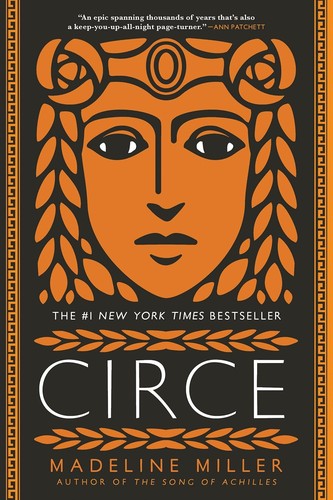
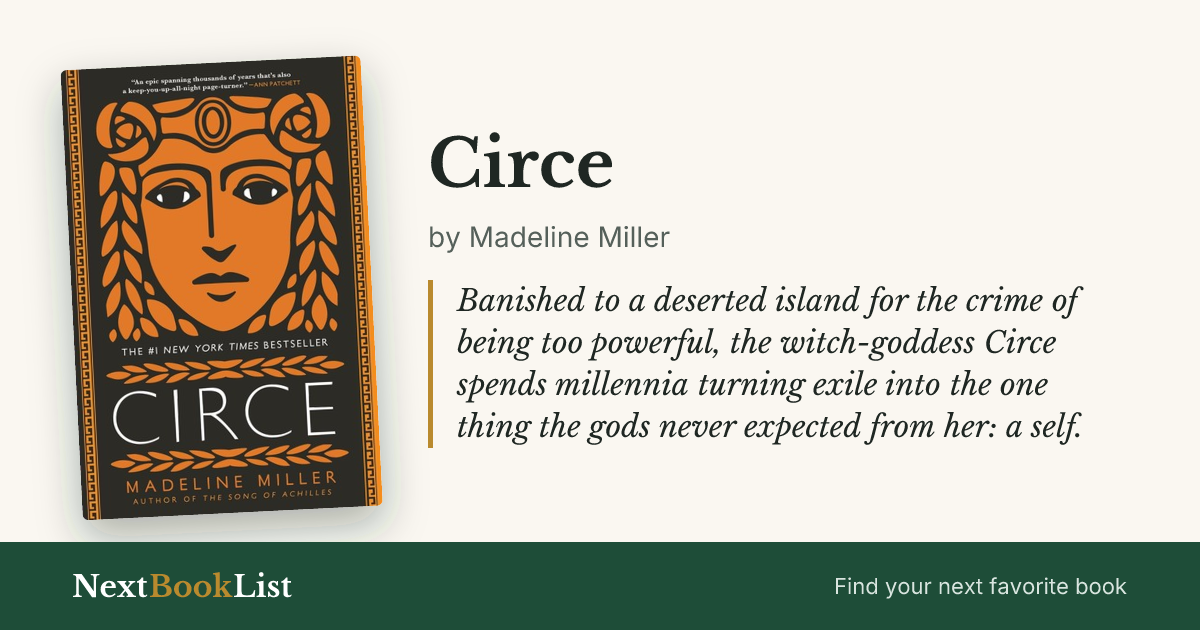
Circe
by Madeline Miller · 2018
Banished to a deserted island for the crime of being too powerful, the witch-goddess Circe spends millennia turning exile into the one thing the gods never expected from her: a self.
Worth reading? The best mythology retelling of its decade -- slower than a plot-driven fantasy, but the prose and the arc both earn it.
| Author | Madeline Miller |
|---|---|
| Published | 2018 |
| Publisher | Little, Brown and Company |
| Category | Fiction |
| Favorite quote | “I have a mortal's voice, let me have the rest.” |
The Verdict
Miller’s prose is the whole case for this book – clean, controlled, and unusually good at making centuries of solitude feel eventful rather than static. That’s a hard needle to thread and the book mostly threads it.
The tradeoff is pace. Long stretches are Circe alone with her craft and her thoughts, and if you’re reading for plot momentum the way you’d read a thriller, those chapters will feel slow regardless of how good the sentences are. The famous set pieces (Scylla, Odysseus, the transformation of the sailors) are genuinely great when they arrive, but they arrive with a lot of quiet in between.
Skip it if you want a fast mythological adventure – this is closer to a character study that happens to be set inside Greek myth. Read it if you want the myth reframed from the perspective of the woman the original stories treated as a monster, and you’re fine taking your time to get there.
you want Greek mythology retold from the margins, with prose good enough to justify the hype, and a protagonist whose arc is about earning selfhood rather than winning a war
you want fast-moving plot -- large stretches of the book are Circe alone on her island, and the pacing rewards patience with interiority over incident
Book Summary
Circe is the daughter of the sun god Helios, minor and mocked among the Olympians until she discovers she has the power of witchcraft -- transformation, mostly, the one power the gods themselves don't have. For using it, she's exiled alone to the island of Aiaia, where she spends what amounts to a divine eternity refining her craft, occasionally visited by figures out of Greek myth (Hermes, Daedalus, Odysseus) who each leave her changed.
Miller's real interest isn't the myths themselves -- most readers already know how Circe turns Odysseus's men into pigs -- it's what centuries of enforced solitude do to someone who started out powerless and mocked. The book reframes Circe's most famous myth (the pig transformation) as an act of self-defense rather than cruelty, and treats her long exile less as punishment than as the space where she finally becomes someone rather than something.
The novel's quiet argument is that mortality, which the gods treat as a curse, is actually what makes a life meaningful -- stakes, change, and an ending are what Circe comes to envy about the humans she watches, not their weakness.
Top 8 Lessons from Circe
- Circe's exile, meant as punishment, becomes the isolation she needs to develop her own power on her own terms, away from a family that only valued her as a non-threat.
- The famous myth of Circe turning men into pigs is reframed here as self-defense against sailors who assume a lone woman is easy prey, not casual cruelty.
- Immortality without change is its own kind of prison -- the gods' unchanging nature is what Circe eventually envies mortals for escaping, not the reverse.
- Being underestimated by everyone around you can be its own kind of freedom -- nobody expects Circe to become dangerous, which is exactly what lets her become dangerous.
- Motherhood in the book is treated as fierce and unglamorous, not sentimental -- Circe's devotion to her son Telegonus is one of the few things she never treats as a divine transaction.
- Power without consequence, which is what the Olympians have, produces cruelty by default -- it's mortality's stakes that force Circe toward something like real ethics.
- Choosing an ordinary, finite life over an easy immortal one is presented as the book's real climax, not any battle or spell.
- Every man who visits Circe's island (Hermes, Odysseus, Daedalus) changes her, but the book is careful that none of them defines her -- she outlasts all of their versions of who she should be.
Top 4 Quotes from Circe
"I have a mortal's voice, let me have the rest."
Madeline Miller, Circe
"When we are young, we think ourselves the first to have each feeling in the world."
Madeline Miller, Circe
"I will not be like a bird bred in a cage, too dull to fly even when the door stands open."
Madeline Miller, Circe
"Do not try to take my regret from me. My regret is mine."
Madeline Miller, Circe
Frequently Asked Questions
Is Circe worth reading?
Yes, if you want a slow, prose-driven mythology retelling -- it's less plot-forward than most fantasy, but the craft and the arc justify the reputation.
Do I need to know Greek mythology to read Circe?
No. Miller reintroduces every myth she uses, and the emotional throughline works even if you've never read Homer.
Is Circe a sequel to The Song of Achilles?
No, it's a separate standalone novel, though both books share Miller's interest in retelling Greek myth from an overlooked perspective, and Circe appears briefly in The Song of Achilles.
Is Circe slow-paced?
Yes, especially the island chapters -- it's an interior, character-driven novel rather than an action-driven one. Go in expecting a character study, not an adventure.
Ready to read it?
Get Circe on Amazon