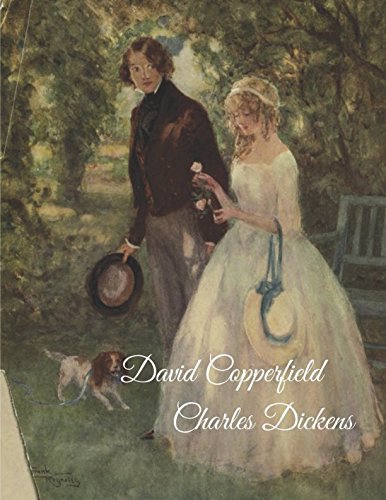
David Copperfield
by Charles Dickens · 1850
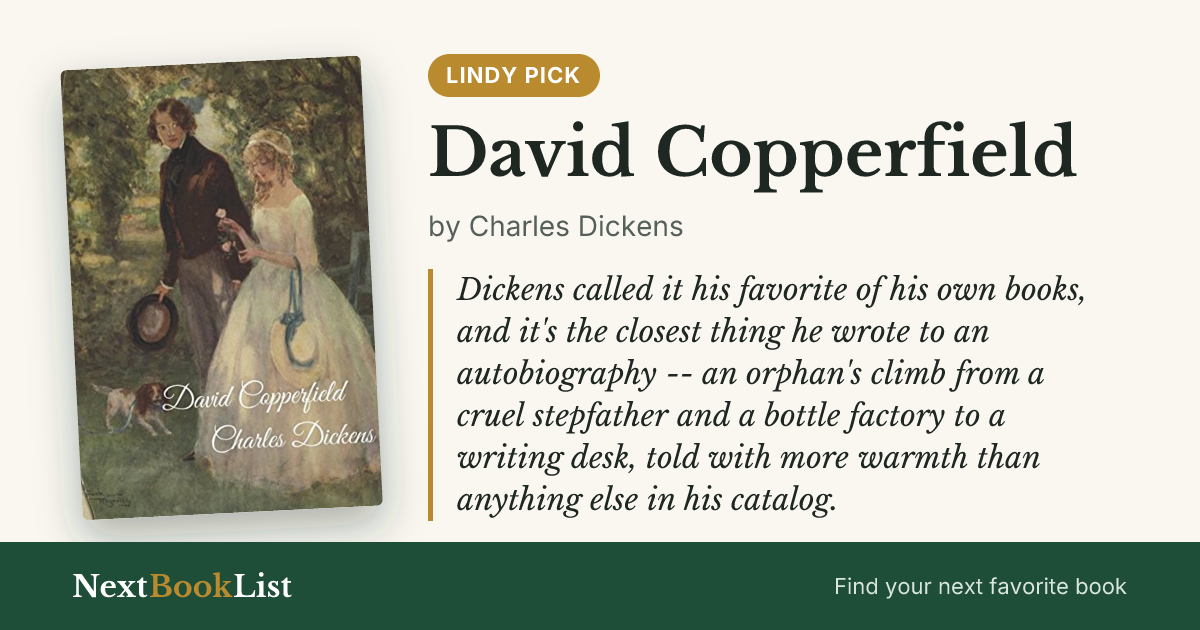
Dickens called it his favorite of his own books, and it's the closest thing he wrote to an autobiography -- an orphan's climb from a cruel stepfather and a bottle factory to a writing desk, told with more warmth than anything else in his catalog.
Worth reading? David Copperfield is Dickens at his most personal, and it shows. He drew on his own childhood -- the debtor's prison, the factory work, the string of unstable homes -- and the result reads less like social satire (which is where Dickens usually operates) and more like something closer to a confession. It's also his longest, baggiest book, which is the real trade-off: you get more heart, but you pay for it in pages.
| Full Title | The Personal History of David Copperfield |
|---|---|
| Author | Charles Dickens |
| Published | 1850 |
| Publisher | Penguin Classics |
| Category | Fiction |
| Favorite quote | “Whether I shall turn out to be the hero of my own life, or whether that station will be held by anybody else, these pages must show.” |
The Verdict
The first hundred pages, David’s childhood under Mr. Murdstone, are as bleak as anything Dickens wrote, and they hit harder because you can feel he’s not making it up. Once David escapes to his aunt Betsey Trotwood’s house, the book opens up into the sprawling, character-stuffed novel Dickens is known for, and it never fully lets go of that early darkness even when it’s being funny.
Uriah Heep and Mr. Micawber are the two performances that make the book worth the length. Heep’s fake humility is one of the great villain voices in English fiction, and Micawber’s chronic, cheerful insolvency is funny precisely because Dickens knew that particular desperation firsthand.
Read it if you want the most emotionally honest Dickens novel and don’t mind an 800-plus-page commitment. Skip it if you want tight plotting – David’s romantic subplots, especially the Dora Spenlow chapters, sag in the middle third and could’ve lost fifty pages without losing anything real.
you want the most personal, most emotionally direct Dickens novel, with a huge cast of memorable side characters and a plot that actually rewards patience
you want Dickens's tightest, fastest-moving book -- this one runs long and wanders through a lot of subplots before it pays them all off
Book Summary
David loses his father before birth, then his mother to a cruel stepfather who ships him off to a bottle-labeling factory as a child laborer, and the first third of the book is essentially Dickens processing his own childhood trauma through a fictional stand-in.
The novel is structured as an autobiography in form, David narrating his own life from infancy to adulthood, which lets Dickens track how the people who shaped his childhood (Peggotty, Mr. Micawber, Uriah Heep, Betsey Trotwood) keep reappearing and changing shape as David's understanding of them matures.
Underneath the plot, the book keeps returning to one question: what makes someone "the hero of his own life," as the opening line puts it -- and Dickens's answer has less to do with talent or luck than with who shows you real kindness when you have nothing to offer back.
Top 8 Lessons from David Copperfield
- David's stepfather Mr. Murdstone runs the household on 'firmness,' a euphemism Dickens uses throughout the book for domestic cruelty dressed up as discipline.
- Mr. Micawber, perpetually broke and perpetually certain 'something will turn up,' is Dickens's fictionalized version of his own father, who was jailed for debt.
- Uriah Heep's constant performance of humility ('I am well aware that I am the umblest person going') is the book's clearest study of manufactured meekness as a tool for manipulation.
- Betsey Trotwood, David's eccentric aunt, upends the era's assumptions about women by being the most competent, decisive adult in the book.
- David's early marriage to Dora Spenlow, sweet but incapable of running a household, is Dickens's honest account of choosing a partner for charm over compatibility.
- The novel treats child labor and debtor's prisons not as background color but as the direct cause of the damage David spends the rest of the book recovering from.
- Steerforth, David's charming schoolboy idol, turns out to be the novel's sharpest warning about mistaking charisma for character.
- The book's structure -- an old man narrating his own life story -- lets Dickens show David misjudging people as a child and correcting that judgment as an adult, without ever breaking the first-person voice.
Top 4 Quotes from David Copperfield
"Whether I shall turn out to be the hero of my own life, or whether that station will be held by anybody else, these pages must show."
Charles Dickens, David Copperfield
"I never could have done what I have done, without the habits of punctuality, order, and diligence, without the determination to concentrate myself on one object at a time."
Charles Dickens, David Copperfield
"Annual income twenty pounds, annual expenditure nineteen nineteen and six, result happiness. Annual income twenty pounds, annual expenditure twenty pounds ought and six, result misery."
Charles Dickens, David Copperfield
"My advice is, never do tomorrow what you can do today. Procrastination is the thief of time."
Charles Dickens, David Copperfield
Frequently Asked Questions
Is David Copperfield worth reading?
Yes, if you want Dickens at his most personal -- it's the novel he called his favorite of his own work, and the emotional core is stronger than the social satire he's better known for.
What is David Copperfield about?
An orphan's journey from a cruel stepfather and child labor in a bottle factory to adulthood as a writer, narrated as his own autobiography and populated by one of Dickens's largest supporting casts.
Is David Copperfield hard to read?
Not difficult sentence by sentence, but it's long -- close to 900 pages in most editions -- and it takes its time getting through David's childhood before the plot picks up speed.
Is David Copperfield based on Dickens's own life?
Largely, yes. The child labor, the debtor's prison, and the path into writing all mirror Dickens's own biography closely enough that critics treat it as his most autobiographical novel.
Do I need to read other Dickens novels first?
No, it stands alone fine. If anything it's a reasonable entry point into Dickens, since the emotional stakes are clearer than in his more plot-heavy social novels.
Ready to read it?
Get David Copperfield on Amazon