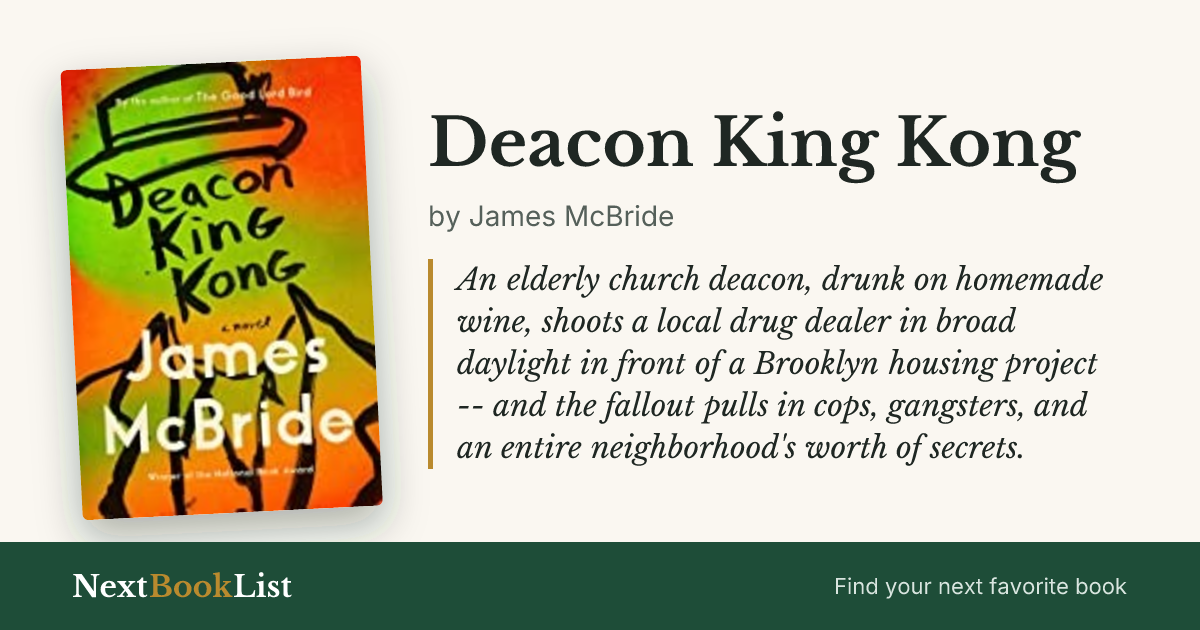
Deacon King Kong
by James McBride · 2020
An elderly church deacon, drunk on homemade wine, shoots a local drug dealer in broad daylight in front of a Brooklyn housing project -- and the fallout pulls in cops, gangsters, and an entire neighborhood's worth of secrets.
Worth reading? Deacon King Kong takes an inciting incident, a drunk old deacon shooting a drug dealer, that sounds like the setup for a tight crime novel, and instead uses it to unspool an entire South Brooklyn housing project's worth of life. McBride's affection for his characters is total, and the book's warmth and humor never undercut its clear-eyed view of how a neighborhood survives drugs, poverty, and institutional neglect.
| Author | James McBride |
|---|---|
| Published | 2020 |
| Publisher | Riverhead Books |
| Category | Fiction |
The Verdict
McBride’s gift is refusing to let any character in this book be a type. The mob associate, the addict, the church lady who runs everything from the pews, each gets enough specificity that the sprawling cast never feels like padding.
If you came in expecting a crime novel built around the shooting and its investigation, recalibrate. That’s the engine that starts the book moving, but McBride is much more interested in where it takes him, which is everywhere in this neighborhood at once.
Read it if you want a big, generous, funny novel about a community surviving hard circumstances together. Skip it if you need the plot to stay tightly focused on the initial crime.
you want a big, funny, generous novel about a Brooklyn community in the late 1960s, full of memorable characters and McBride's gift for finding humanity, and humor, in people the rest of the world writes off
you want a tight, plot-first crime novel -- this sprawls across a huge cast and follows its own tangents, and the shooting is more a launching point than the book's central focus
Book Summary
In September 1969, Cuffy "Sportcoat" Lambkin, a widowed deacon known for his moonshine drinking and general chaos, walks up to a young drug dealer named Deems in broad daylight and shoots him in front of the Cause Houses housing project. No one, including Sportcoat, can fully explain why, and the incident sets off a chain reaction pulling in the local police, an Italian mob figure with unexpected ties to the projects, church ladies, addicts, and everyone in between.
McBride uses the shooting less as a mystery to solve than as a pretext for a sprawling portrait of the Cause Houses community, its church, its underground economy, its long memory, treating even minor characters with the same care and specificity as his leads, and finding real comedy in the absurdity of Sportcoat's chaos alongside real grief in the neighborhood's losses.
The novel builds toward a series of quiet redemptions and reconciliations rather than a conventional crime-plot resolution, arguing implicitly that community, faith, and stubborn human connection outlast the drugs and violence that seem, on the surface, to define the neighborhood.
Top 10 Lessons from Deacon King Kong
- The shooting that opens the novel functions as a pretext for a wide community portrait rather than the central mystery the plot resolves around -- McBride is more interested in the neighborhood than the crime.
- The book treats even minor and comedic characters (church ladies, addicts, mobsters) with real specificity and dignity, resisting the temptation to use them as background color.
- McBride finds humor consistently in Sportcoat's chaos without minimizing the real damage of addiction, poverty, and violence surrounding him -- comedy and gravity coexist rather than canceling each other out.
- Institutional neglect (housing, policing, the drug trade filling vacuums left by disinvestment) is treated as a structural backdrop the characters navigate, not an abstract talking point.
- The novel resolves through quiet acts of reconciliation and redemption rather than a conventional crime-plot climax, prioritizing community healing over plot mechanics.
- Faith and church community function as genuine, if imperfect, sources of stability and meaning for characters navigating chaos, treated sincerely rather than ironically.
- A legendary hidden Christmas Club fund gives the sprawling ensemble a shared, almost mythic goal that eventually connects most of the novel's major characters to one another.
- Sportcoat's ongoing conversations with his dead wife Hettie work as both a comic device and the novel's way of keeping grief present in the story without turning maudlin about it.
- The mob associate Elefante's storyline links the housing project's underground economy to organized crime across the wider city, showing the neighborhood's fate is tied to forces well outside it.
- McBride's close third-person narration hops between a dozen-plus characters, letting the reader see the same events refracted through very different perspectives on the same block.
Frequently Asked Questions
Is Deacon King Kong worth reading?
Yes -- it's a warm, funny, big-hearted novel and one of McBride's most acclaimed books, praised for its generous portrait of a Brooklyn community.
What is Deacon King Kong about?
An elderly, drunk church deacon shoots a local drug dealer in a Brooklyn housing project in 1969, and the incident unravels into a portrait of the entire surrounding community.
Is Deacon King Kong a crime novel?
It opens with a shooting, but it's really a community novel -- the crime plot is a pretext for a much wider, character-driven story.
Is Deacon King Kong a funny book?
Yes, genuinely -- McBride finds real comedy in Sportcoat's chaos without minimizing the neighborhood's real struggles with poverty and addiction.
Was Deacon King Kong a bestseller?
Yes -- it was a New York Times bestseller and one of Barack Obama's favorite books of 2020.
Ready to read it?
Get Deacon King Kong on Amazon