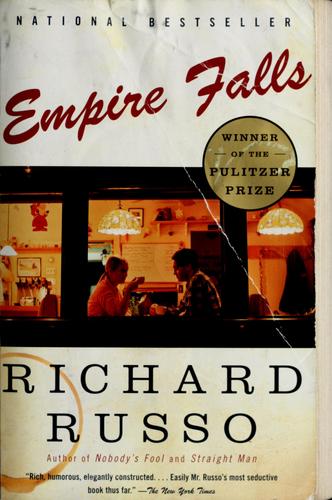
Empire Falls
by Richard Russo · 2001
A middle-aged diner manager in a dying Maine mill town spends the novel not making the decisions that could change his life, while the town's wealthiest family quietly controls everything around him -- and Russo makes that stasis the whole point.
Worth reading? Empire Falls is a novel about inertia that somehow never feels inert -- Russo spends most of the book on a man who won't act, and makes that refusal to act the most tense thing happening in the story.
| Author | Richard Russo |
|---|---|
| Published | 2001 |
| Publisher | Vintage |
| Category | Fiction |
The Verdict
Russo’s patience is the whole strategy here. Miles’s refusal to make the big decisions in his own life could easily have made for a frustrating protagonist, but the slow accumulation of town detail, family history, and quiet class resentment keeps the stasis genuinely tense rather than static on the page.
The late turn toward violence is the novel’s biggest risk, and it works specifically because Russo hasn’t been telegraphing it. It reframes the whole slow build that came before it rather than feeling bolted on for a dramatic ending.
Read it if you want a patient, richly observed literary novel about small-town decline and one man’s reckoning with his own inertia. Skip it if you need consistent forward momentum – this book asks you to trust a long, slow burn.
you want patient, character-driven literary fiction about small-town decline, class resentment, and a man's slow reckoning with his own passivity
you want a fast-moving plot -- this is a long, deliberately unhurried novel, and its considerable payoff arrives late and depends on you staying with the slow build
Book Summary
Miles Roby manages the Empire Grill, a diner in a fading Maine mill town controlled almost entirely by the wealthy Whiting family, who own the land under Miles's business and much of the town besides. Miles has spent years deferring his own life -- an unfinished degree, a stalled divorce, a promise his mother extracted from him decades ago -- in a kind of low-grade paralysis Russo treats with real sympathy and real critique at once.
Russo builds the town of Empire Falls as a character in its own right: the closed textile mill, the class resentment between the Whitings and everyone who works for them, and the slow economic decline that's hollowed out the town's sense of possibility. Miles's personal stasis mirrors the town's broader decline without being a heavy-handed metaphor for it.
The novel's structure alternates present-day chapters with Miles's teenage daughter Tick's own coming-of-age story at the local high school, building toward a violent event that recontextualizes everything that came before -- a tonal shift Russo earns through the slow accumulation of small-town detail rather than foreshadowing it heavily.
Top 7 Lessons from Empire Falls
- Miles's passivity isn't played as a character flaw to be fixed quickly -- Russo treats years of deferred decisions with genuine psychological weight and doesn't rush his growth.
- The Whiting family's control over the town's land and businesses is the novel's clearest expression of class power operating quietly rather than through obvious villainy.
- Empire Falls's economic decline (the closed mill, the fading Main Street) is drawn with enough specificity that the town functions as its own character, not just a backdrop.
- Tick's high school storyline, running parallel to Miles's, gives the novel a second generation's version of the same themes -- powerlessness, social hierarchy, and who gets to leave.
- The novel's late tonal shift toward violence is set up through patient accumulation of small details rather than overt foreshadowing, which is why it lands as devastating rather than melodramatic.
- Miles's relationship with his ex-wife and his own father are both used to show how patterns of avoidance and resentment get passed down without anyone intending them to.
- Russo balances real comedy (diner regulars, small-town gossip) against the novel's heavier class and violence themes without either undercutting the other.
Frequently Asked Questions
Is Empire Falls worth reading?
Yes, if you're willing to be patient -- it's a slow-building literary novel that pays off substantially by the end.
Did Empire Falls win any awards?
Yes -- it won the 2002 Pulitzer Prize for Fiction.
Is the TV adaptation worth watching?
The 2005 HBO miniseries, with a cast including Paul Newman and Ed Harris, is well-regarded and fairly faithful to the novel.
Is this a fast-paced book?
No -- it's deliberately unhurried for most of its length, building toward a late, significant tonal shift rather than sustaining constant plot momentum.
Do you need to be from a small town to relate to this book?
No, but the novel's specificity about small-town economic decline and class resentment will land hardest if that world is at all familiar.
Ready to read it?
Get Empire Falls on Amazon