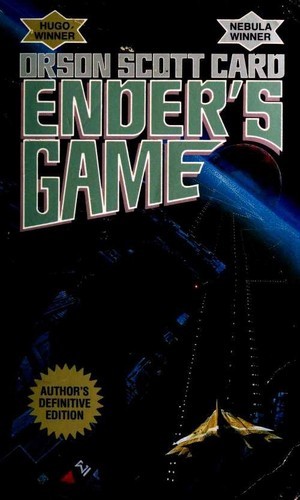
Ender's Game
by Orson Scott Card · 1985
A six-year-old genius is drafted into a military academy in orbit and trained through increasingly brutal war games to command Earth's fleet against an alien species -- and the twist about what he's actually been doing the whole time is one of science fiction's most effective gut-punches.
Worth reading? Ender's Game earns its reputation on plotting alone -- Card builds Ender's isolation, the escalating war games, and the final twist with real precision, and the ending genuinely lands even if you've heard the twist coming. Where it's more contested is everything around the book: Card's other writing and public political activity have made this one of the more debated 'can you separate the art from the artist' cases in modern genre fiction, and that's worth knowing before you pick it up, not after.
| Author | Orson Scott Card |
|---|---|
| Published | 1985 |
| Publisher | Tor Books |
| Category | Fiction |
| Favorite quote | “In the moment when I truly understand my enemy, understand him well enough to defeat him, then in that very moment I also love him.” |
The Verdict
The twist is the reason Ender’s Game gets recommended so often, and it’s earned: Card spends the whole book building Ender’s isolation and the escalating brutality of his training with enough precision that the reveal recontextualizes everything without feeling like a cheap trick.
What the book asks underneath the plot is genuinely uncomfortable and doesn’t get resolved neatly – whether a child manipulated into violence bears moral responsibility for it, and whether the adults who engineered that manipulation are ever really held accountable. Card doesn’t offer an easy answer, and that’s to the book’s credit.
It’s worth being direct about the other half of this: Orson Scott Card’s public opposition to same-sex marriage and his political activity on the subject are well documented, and a real number of readers choose not to support his work because of it. That’s a legitimate call to make, and it’s worth making with full information rather than after the fact.
Read it if you want tightly plotted science fiction built around a genuinely devastating twist and real moral weight. Skip it if you’d rather not engage with the author’s public political record, which for many readers is inseparable from the book itself.
you want tightly plotted, morally uncomfortable military science fiction that works for teen and adult readers alike, built around a genuinely devastating structural twist
you can't separate the work from its author -- Orson Scott Card's public views, particularly his opposition to same-sex marriage, have led a significant number of readers to boycott his books entirely, and that's a legitimate reason to pass
Book Summary
Ender Wiggin, a six-year-old prodigy bred specifically to be a military commander, is taken from his family to Battle School, an orbital military academy that trains children through simulated zero-gravity combat games to prepare humanity's next fleet commander against an alien species, the Formics, who nearly wiped out humanity in an earlier war.
Card structures Ender's training as deliberate, engineered isolation -- adults manipulate his relationships with other children, escalate the difficulty and cruelty of his trials without warning, and push him toward violence specifically to shape him into the commander they need, even as the book makes clear this is psychologically brutal for a child.
The novel's twist, revealed at its climax, recontextualizes everything Ender believed he was doing during his final training exercises, and Card uses it to ask a genuinely uncomfortable question about complicity, manipulation, and whether a child can be held morally responsible for violence he was deceived into committing.
Top 7 Lessons from Ender's Game
- Ender's entire education is built on deliberate isolation -- adults repeatedly manipulate his peer relationships and escalate his trials specifically to force him to solve problems alone, which the book presents as both effective training and genuine psychological cruelty.
- The novel's central twist recontextualizes Ender's final 'training' exercises entirely, and Card uses that reveal to raise a real question about complicity: can someone be held morally responsible for actions they were deliberately deceived into taking?
- Ender's older brother Peter and sister Valentine run a parallel plot on Earth, using assumed political identities to influence global politics online -- an unusually prescient subplot about anonymous online persuasion and reputation for a book published in 1985.
- The adults running Battle School genuinely believe the ends (humanity's survival against the Formics) justify treating a child as a weapon to be engineered, and the book doesn't let them off the hook for that even as it also doesn't offer an easy alternative.
- Ender's specific gift, throughout the book, is his ability to deeply understand an opponent -- to the point of loving them -- which the book frames as the same capacity that makes him both an exceptional strategist and the perfect tool for what's eventually asked of him.
- The novel's use of children as the primary cast, fighting a war designed and directed entirely by adults, is a deliberate choice that lets Card interrogate how institutions instrumentalize young people without their full understanding or consent.
- Orson Scott Card's public opposition to same-sex marriage and his activity with the National Organization for Marriage have led many readers and some retailers to boycott his work, a controversy that's inseparable from any current discussion of whether to read this book.
Top 4 Quotes from Ender's Game
"In the moment when I truly understand my enemy, understand him well enough to defeat him, then in that very moment I also love him."
Orson Scott Card, Ender's Game
"There is no teacher but the enemy."
Orson Scott Card, Ender's Game
"I destroy them. I make it impossible for them to ever hurt me again. I grind them and grind them until they don't exist."
Orson Scott Card, Ender's Game
"The power to cause pain is the only power that matters, the power to kill and destroy, because if you can't kill then you are always subject to those who can, and nothing and no one will ever save you."
Orson Scott Card, Ender's Game
Frequently Asked Questions
Is Ender's Game worth reading?
Yes, for the plotting and the twist -- it's a tightly built book about childhood, manipulation, and complicity, though the author's public political activity is a real factor some readers weigh before picking it up.
What is the twist in Ender's Game?
Without spoiling it directly, it recontextualizes what Ender believed his final training exercises were, and it's widely considered one of science fiction's most effective structural twists.
Is Ender's Game appropriate for teens?
Yes -- it's commonly assigned in schools and read by teens, though its themes of manipulation, violence, and moral complicity are handled with real weight rather than softened.
Why do some people boycott Orson Scott Card's books?
Card has publicly opposed same-sex marriage and served on the board of the National Organization for Marriage, which has led many readers and some retailers to boycott his work, including Ender's Game.
How many books are in the Ender's Game series?
Card has written numerous sequels and parallel novels (the Ender Quintet and the Shadow series), though Ender's Game is the most widely read and works as a standalone.
Ready to read it?
Get Ender's Game on Amazon