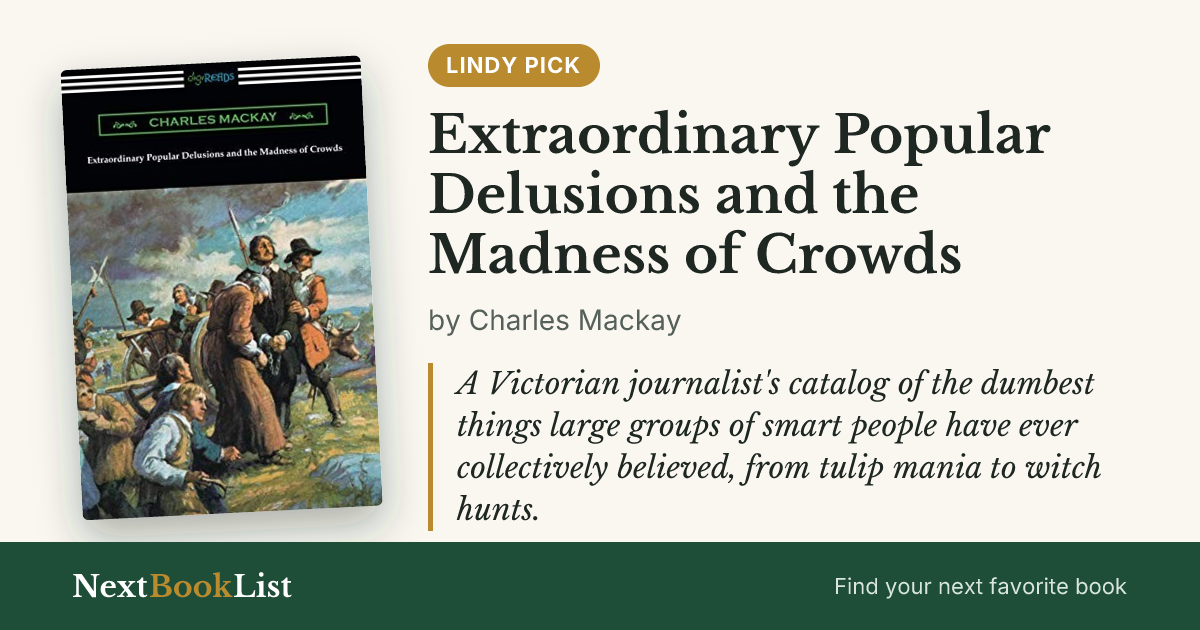
Extraordinary Popular Delusions and the Madness of Crowds
by Charles Mackay · 1841
A Victorian journalist's catalog of the dumbest things large groups of smart people have ever collectively believed, from tulip mania to witch hunts.
Worth reading? This 1841 book is the original behavioral-finance text, written a century and a half before the field had a name. Mackay wasn't an economist; he was a journalist with a notebook and a sense of the absurd, and that's exactly why it holds up. Economists built models; Mackay just showed you the corpses. If you've ever been tempted by a hot asset, a can't-lose trend, or a consensus that 'everyone agrees,' read this first. The specifics (tulips, Mississippi schemes) are quaint; the mechanism, that groups of intelligent people will jointly believe nonsense and call it wisdom, is eternal. It pairs perfectly with any modern book on bubbles. The modern ones give you the psychology; Mackay gives you 800 years of proof it keeps happening.
| Full Title | Extraordinary Popular Delusions and the Madness of Crowds |
|---|---|
| Author | Charles Mackay |
| Published | 1841 |
| Publisher | CreateSpace Independent Publishing Platform |
| Category | Business & Money |
| Favorite quote | “Men, it has been well said, think in herds; it will be seen that they go mad in herds, while they only recover their senses slowly, and one by one.” |
The Verdict
Mackay’s 1841 chronicle of mass delusions, tulip manias, bubble schemes, witch hunts, is the original crowd-psychology text. The technology changes every generation; the madness doesn’t.
Read it if you invest, follow trends, or want a permanent vaccine against 'this time is different.'
Skip it if you want a tidy framework. It's a sprawling, gossipy history of human stupidity, not a model.
Book Summary
Mackay's thesis is that humans, in groups, lose the sense they'd have alone. The crowd overrides the individual's judgment, and the result is bubbles, panics, and crazes that look insane in hindsight and obvious only after.
His centerpiece is the South Sea Bubble and the Dutch tulip mania, where a single tulip bulb briefly cost more than a house. People knew it was absurd and bought anyway, because everyone else was, and selling to a greater fool felt like profit.
The book is 180 years old and reads like a live report on crypto, meme stocks, and every boom you've lived through. The technology changes; the madness doesn't.
Top 10 Lessons from Extraordinary Popular Delusions and the Madness of Crowds
- Crowds are dumber than the individuals in them. Alone you'd never buy a tulip for a house; in a crowd you do it laughing.
- Bubbles are old. The Dutch tulip mania (1630s) and South Sea Bubble (1720) predate modern markets by centuries. We didn't invent irrational exuberance.
- 'This time is different' is the four most expensive words in investing. It never is, behaviorally.
- The greater-fool theory always ends. You can profit selling to a fool until you're the fool left holding it.
- Manias need a story, not a spreadsheet. The narrative is what infects the crowd, not the numbers.
- Witch hunts and money crazes are the same disease: a group agreeing to believe something absurd together.
- Watch what people defend with anger rather than evidence. Certainty in a crowd is a warning sign, not a comfort.
- Famous men are not immune. The smartest investors in history lost fortunes in bubbles because crowds swallow everyone.
- History doesn't repeat exactly, but it rhymes because the human animal doesn't upgrade.
- The cure is distance. Step outside the noise, read the old account of the last craze, and you'll see the new one clearly.
Top 4 Quotes from Extraordinary Popular Delusions and the Madness of Crowds
"Men, it has been well said, think in herds; it will be seen that they go mad in herds, while they only recover their senses slowly, and one by one."
Charles Mackay, Extraordinary Popular Delusions and the Madness of Crowds
"We find that whole communities suddenly fix their minds upon one object, and go mad in its pursuit; that millions of people become simultaneously impressed with one delusion, and run after it, till their attention is caught by some new folly more captivating than the first."
Charles Mackay, Extraordinary Popular Delusions and the Madness of Crowds
"Money, again, has often been a cause of the delusion of multitudes. Sober nations have all at once become desperate gamblers, and risked almost their existence upon the turn of a piece of paper."
Charles Mackay, Extraordinary Popular Delusions and the Madness of Crowds
"Every age has its peculiar folly: some scheme, project, or fantasy into which it plunges, spurred on by the love of gain, the necessity of excitement, or the mere force of imitation."
Charles Mackay, Extraordinary Popular Delusions and the Madness of Crowds
Frequently Asked Questions
Is this a finance book or a history book?
Both. Mackay was a journalist chronicling famous mass delusions, the tulip bubble, the South Sea Bubble, alchemy, witch hunts, so it reads as history, but investors treat it as the founding text of crowd psychology.
Why is it still relevant?
Because the technology changes and the behavior doesn't. Every boom from dot-com to crypto is the same crowd mechanics Mackay documented in 1841. The book is a permanent 'this time is different' detector.
Is it hard to read?
It's long and 19th-century in style, but each chapter is a self-contained story of a delusion, so you can dip in. The tulip and South Sea chapters alone are worth the price.