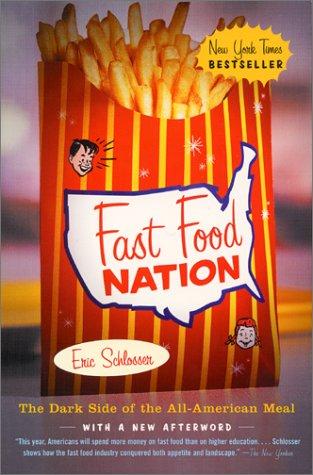
Fast Food Nation
by Eric Schlosser · 2001
The fast food industry didn't just change what America eats, it restructured farming, ranching, meatpacking, and the entire teenage labor market to feed a drive-through window -- and Schlosser traces the whole supply chain to show the real cost behind a cheap burger.
Worth reading? Fast Food Nation earns comparisons to The Jungle because it does the same thing Sinclair did a century earlier -- follows the industrial process behind a cheap, ubiquitous meal until the reader can't unsee it. The meatpacking chapters are the most damning and the best-reported part of the book; the franchise economics and teenage-labor sections are the parts that explain why the industry works the way it does at all.
| Full Title | Fast Food Nation: The Dark Side of the All-American Meal |
|---|---|
| Author | Eric Schlosser |
| Published | 2001 |
| Publisher | Harper Perennial |
| Category | Business & Money |
| Favorite quote | “The history of the twentieth century was dominated by the struggle against totalitarian systems of state power. The twenty-first will no doubt be marked by a struggle to curtail excessive corporate power.” |
The Verdict
The meatpacking chapters are what people remember, and for good reason – Schlosser gets specific about line speeds, injury rates, and the immigrant labor force absorbing most of the risk, and the detail is what makes it land instead of reading like a generic industry criticism.
What holds the book together is the supply-chain structure: Schlosser follows the money and the process from cattle ranch to slaughterhouse to the register, so by the time you’re reading about children’s marketing and teenage labor turnover, you already understand the economics forcing those choices.
Read it if you want investigative journalism that follows an entire industry’s supply chain and doesn’t flinch at the ugly parts. Skip it if you’re looking for nutrition advice or calorie information – that’s not what this book is doing.
you want investigative business journalism that follows a single industry's supply chain end to end, from feedlot to slaughterhouse to the register
you're looking for a nutrition or diet book -- Fast Food Nation is about industry structure, labor, and agriculture, not calorie counts or personal health advice
Book Summary
Schlosser traces the fast food industry's growth from a handful of postwar drive-ins into a business model that reshaped American agriculture, meatpacking, and labor markets, arguing the industry's relentless drive for cheap, standardized food had consequences far beyond the restaurant itself.
The book's meatpacking chapters document unsafe, high-speed slaughterhouse conditions and the industry's reliance on low-wage, often immigrant labor, tying food safety problems directly to labor practices rather than treating them as separate issues.
Schlosser also examines how fast food chains deliberately targeted children through marketing and built a business model around low-wage, high-turnover teenage labor, arguing the industry's economics depend on keeping both its customers and its workforce young and easy to influence.
Top 8 Lessons from Fast Food Nation
- Fast food chains built their business model around low-wage, high-turnover teenage labor, using standardized processes designed to require minimal training or skill.
- The industry's demand for cheap, uniform beef reshaped American cattle ranching and led to the consolidation of meatpacking into a handful of massive, high-speed slaughterhouse operations.
- High-speed slaughterhouse lines, documented in the book's meatpacking chapters, directly increased injury rates and food contamination risk, tying worker safety and food safety to the same root cause.
- Fast food companies marketed heavily and specifically to children, using play areas, toys, and characters to build brand loyalty from an early age, a strategy Schlosser treats as a deliberate business decision, not incidental.
- Franchise economics push individual restaurant owners to cut labor costs aggressively, since food and real estate costs are largely fixed by the corporate parent -- labor becomes the main lever owners can control.
- The industry's reliance on immigrant labor in meatpacking plants, often in dangerous conditions, mirrors labor patterns Schlosser compares directly to those Upton Sinclair documented in The Jungle nearly a century earlier.
- Flavor itself became an industrialized product -- the book describes how chemical flavor companies manufacture the tastes and smells associated with fast food, a process most customers never think about.
- Schlosser argues fast food's standardization, the same predictability that makes it commercially successful worldwide, is inseparable from the labor and agricultural practices that make that predictability cheap.
Top 4 Quotes from Fast Food Nation
"The history of the twentieth century was dominated by the struggle against totalitarian systems of state power. The twenty-first will no doubt be marked by a struggle to curtail excessive corporate power."
Eric Schlosser, Fast Food Nation
"Unlike other commodities, however, fast food isn't viewed, read, played, or worn. It enters the body and becomes part of the consumer. No other industry offers, both literally and figuratively, so much insight into the nature of mass consumption."
Eric Schlosser, Fast Food Nation
"What we eat has changed more in the last forty years than in the previous forty thousand."
Eric Schlosser, Fast Food Nation
"Americans now spend more money on fast food than on higher education, personal computers, computer software, or new cars. They spend more on fast food than on movies, books, magazines, newspapers, videos, and recorded music -- combined."
Eric Schlosser, Fast Food Nation
Frequently Asked Questions
Is Fast Food Nation worth reading?
Yes -- it's thorough investigative journalism that traces an entire industry's supply chain, and it holds up as a business and labor exposé more than as a diet book.
What is Fast Food Nation about?
How the fast food industry's growth reshaped American agriculture, meatpacking, and teenage labor markets, tracing the real cost behind cheap, standardized meals.
Is Fast Food Nation about nutrition?
Not primarily -- it focuses on industry structure, labor conditions, and agricultural supply chains rather than nutrition science or diet advice.
Was Fast Food Nation made into a movie?
Yes -- a loosely fictionalized 2006 film adaptation starred Catalina Sandino Moreno and Ethan Hawke.
Does Fast Food Nation name specific fast food companies?
Yes -- Schlosser names and investigates specific major chains and meatpacking companies rather than discussing the industry only in the abstract.
Ready to read it?
Get Fast Food Nation on Amazon