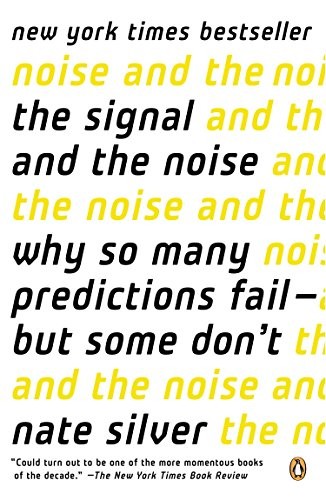
The Signal and the Noise
by Nate Silver · 2012
The statistician who correctly predicted 49 of 50 states in the 2008 election explains why most expert predictions -- in weather, economics, sports, and politics -- fail, and what separates the forecasters who actually get it right.
Worth reading? The Signal and the Noise earns its reputation by staying concrete: instead of teaching probability in the abstract, Silver walks through specific failed and successful predictions -- the 2008 financial crisis, earthquake forecasting, poker, weather models -- and uses each to illustrate a specific, transferable lesson about the difference between confident-sounding predictions and actually well-calibrated ones.
| Full Title | The Signal and the Noise: Why So Many Predictions Fail -- but Some Don't |
|---|---|
| Author | Nate Silver |
| Published | 2012 |
| Publisher | Penguin Press |
| Category | Business & Money |
| Favorite quote | “The signal is the truth. The noise is what distracts us from the truth.” |
The Verdict
What makes this more useful than a typical statistics book is Silver’s insistence on staying concrete. Every chapter is built around a real forecasting failure or success – the 2008 crash, unpredicted earthquakes, weather models that actually got better over decades – rather than abstract probability theory.
The Bayesian reasoning framework is the book’s real takeaway, and Silver makes a genuinely convincing case that treating predictions as continuously updated probabilities, instead of fixed certainties to defend, is the actual skill separating good forecasters from bad ones.
The book runs long, and some chapters (particularly the more technical baseball and chess sections) drag compared to the sharper political and economic case studies.
Read it if you want a concrete, case-study-driven introduction to probabilistic thinking and what separates good forecasters from confident-sounding bad ones. Skip it if you already have a solid statistics background – this is built for general readers, not specialists.
you want a practical, example-driven explanation of probabilistic thinking and Bayesian reasoning, grounded in real forecasting case studies rather than abstract statistics theory
you already have a strong statistics background -- the explanations are built for a general audience and move slowly through concepts a trained statistician already knows
Book Summary
Silver's central argument is that most public predictions fail not because forecasting is impossible, but because forecasters mistake confidence for accuracy -- pundits, economists, and political commentators are rewarded for sounding certain, not for being calibrated, which produces a media and expert culture full of overconfident, poorly tested predictions.
The book champions Bayesian reasoning -- updating your beliefs incrementally as new evidence arrives, rather than committing hard to a single prediction and defending it -- as the practical alternative, using weather forecasting (where meteorologists have gotten genuinely better through exactly this kind of iterative, probabilistic approach) as a model of forecasting done right, contrasted against fields like macroeconomics and earthquake prediction, which have made far less real progress despite decades of study.
Silver draws on his own background building predictive models for baseball (PECOTA) and politics (FiveThirtyEight) to argue that good forecasting requires being honest about uncertainty, expressing predictions as probabilities rather than false certainties, and treating being wrong as informative data rather than a failure to be defended against.
Top 8 Lessons from The Signal and the Noise
- Public forecasters are often rewarded for sounding confident rather than for being accurate, which creates systemic incentives toward overconfident, poorly calibrated predictions in media and punditry.
- Bayesian reasoning -- updating a belief incrementally as new evidence arrives, rather than committing to and defending a single fixed prediction -- is presented as the practical foundation of good forecasting.
- Weather forecasting is held up as a field that has genuinely improved through iterative, probabilistic modeling, in contrast to fields like macroeconomic forecasting, which have shown far less real progress despite decades of academic study.
- The 2008 financial crisis is used as a case study in how ratings agencies and economic models mistook complexity and confidence for genuine predictive accuracy, contributing to a catastrophic miscalibration of risk.
- Earthquake prediction remains largely unsolved despite significant research investment, which Silver uses to illustrate that some systems are inherently far less predictable than the experts studying them like to admit.
- A well-calibrated forecaster expresses predictions as probabilities (a 70% chance of rain) rather than false certainties, and tracks their own track record honestly over time to improve.
- Silver's own experience building PECOTA, a statistical model for predicting baseball player performance, illustrates how a well-built predictive model outperforms traditional scouting intuition in some domains but not all.
- Poker is used as an example of decision-making under genuine uncertainty, where skilled players succeed by thinking in probabilities and expected value rather than seeking false certainty about any single hand.
Top 3 Quotes from The Signal and the Noise
"The signal is the truth. The noise is what distracts us from the truth."
Nate Silver, The Signal and the Noise
"We need to stop, and admit it: we have a prediction problem. We love to predict things -- and we aren't very good at it."
Nate Silver, The Signal and the Noise
"The most calamitous failures of prediction usually have a lot in common. We focus on those signals that tell a story about the world as we would like it to be, not how it really is."
Nate Silver, The Signal and the Noise
Frequently Asked Questions
Is The Signal and the Noise worth reading?
Yes -- it's a practical, example-driven explanation of probabilistic thinking that stays grounded in real forecasting case studies rather than abstract theory.
What is The Signal and the Noise about?
Nate Silver's explanation of why most expert predictions fail across fields like politics, economics, and weather, and how Bayesian reasoning and honest uncertainty produce better forecasts.
Do you need a statistics background to read this book?
No -- Silver writes for a general audience, though readers with strong existing statistics knowledge may find some explanations move slowly.
Is The Signal and the Noise related to FiveThirtyEight?
Yes, Nate Silver founded FiveThirtyEight, the political and sports forecasting site, and draws on that experience throughout the book.
Does the book focus mainly on political forecasting?
No -- it covers a wide range of fields including weather, economics, earthquakes, sports, poker, and chess, using political forecasting as just one of several case studies.
Ready to read it?
Get The Signal and the Noise on Amazon