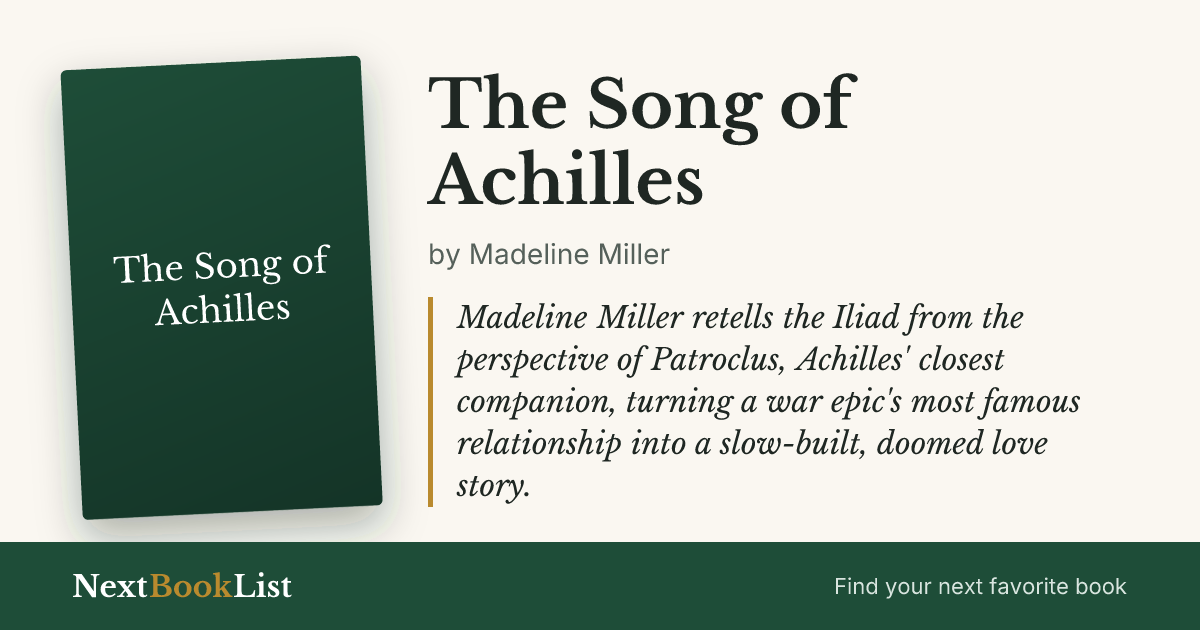
The Song of Achilles
by Madeline Miller · 2011
Madeline Miller retells the Iliad from the perspective of Patroclus, Achilles' closest companion, turning a war epic's most famous relationship into a slow-built, doomed love story.
Worth reading? The Song of Achilles works because Miller trusts the reader to already know how it ends and builds tragedy out of that certainty instead of hiding from it. Patroclus's narration turns Achilles from a battle-epic archetype into a specific, flawed person the reader has watched grow up, which makes the Iliad's ending land as genuine loss rather than distant mythology. The book's pacing is patient -- readers expecting a war novel from the opening pages will need to adjust expectations.
| Author | Madeline Miller |
|---|---|
| Published | 2011 |
| Publisher | Ecco |
| Category | Fiction |
| Favorite quote | “Name one hero who was happy.” |
The Verdict
Miller’s smartest structural choice is trusting you to already know Achilles dies. Instead of building suspense around the outcome, she builds it around the relationship, so by the time the war actually starts, you’re invested in Patroclus and Achilles as specific people, not mythological archetypes.
That patience does mean the pacing is slow by war-epic standards. If you’re expecting battle scenes from page one, you’ll be waiting a while – most of the book is the relationship, not the war.
Read it if you want a literary, emotionally grounded retelling of Greek myth that earns its tragedy instead of just narrating it. Skip it if you want a plot-driven war novel focused on combat – that’s not the book’s real center.
you want a literary retelling of Greek mythology grounded in real emotional stakes, with prose that earns its comparisons to classical epic without being difficult to read
you want a plot-driven war epic focused on battle -- most of the book is the relationship between Patroclus and Achilles building over years before the Trojan War even starts, and the war itself is treated more through its emotional cost than its combat
Book Summary
Miller narrates the story through Patroclus, an exiled prince who becomes Achilles' closest companion during their youth at the court of Achilles' father, and later, in most interpretations the novel leans into directly, his lover.
The novel spends most of its length on the years before the Trojan War -- their training together under the centaur Chiron, the deepening of their relationship, and Achilles' awareness of the prophecy that he will die young but achieve eternal glory if he goes to Troy.
Once the war begins, Miller keeps the narrative focus on Patroclus's perspective and the emotional cost of the conflict -- particularly Achilles' famous refusal to fight after a dispute with Agamemnon, and the consequences of Patroclus's decision to wear Achilles' armor into battle in his place.
The novel closes by extending its emotional focus past Achilles' death (the point where the Iliad itself mostly ends) into the aftermath and its effect on how Achilles is remembered, foregrounding the human relationship the original epic treats as one thread among many.
Top 11 Lessons from The Song of Achilles
- The novel treats Achilles and Patroclus's relationship as explicitly romantic, a reading grounded in ancient interpretive traditions and made central rather than subtextual, which reshapes how the Iliad's central conflict reads emotionally.
- Prophecy and inevitability -- Achilles knows from a young age he'll die young but be remembered forever if he goes to Troy -- can generate genuine narrative tension even when the reader already knows the mythological outcome.
- Fame and legacy, embodied in Achilles' choice of a short glorious life over a long unremarkable one, are treated as a real trade-off with real cost to the people who love him, not just an abstract heroic ideal.
- Achilles' refusal to fight after his dispute with Agamemnon is reframed through Patroclus's eyes as a personal, relational choice with direct consequences for people Achilles loves, not just a matter of wounded pride.
- Retelling a well-known story from a secondary character's point of view can surface emotional stakes the original, hero-centered version treats as background.
- The cost of war in the novel is measured primarily in personal, relational loss rather than in battle spectacle, which is a deliberate departure from how epic war narratives are often told.
- The novel is narrated by Patroclus from beyond his own death, giving the story a retrospective, elegiac quality baked into its structure, not just its ending.
- Chiron's mentorship offers Patroclus and Achilles an alternative model of worth -- healing, music, and wisdom -- that stands apart from the purely martial glory the rest of the world expects of Achilles.
- Thetis, Achilles' divine mother, functions as the novel's clearest opposition to the central relationship, her contempt for Patroclus's mortality embodying the world's broader refusal to take the two men's bond seriously.
- Briseis, the captive woman given to Achilles as war spoils, widens the novel's moral frame beyond its two leads, giving a glimpse of the war's cost to the people on the losing, conquered side.
- The novel treats the causes of the Trojan War (Helen's abduction, the suitors' oath) as distant political machinery that sweeps up Achilles and Patroclus rather than a cause either of them chose or believes in.
Top 4 Quotes from The Song of Achilles
"I could recognize him by touch alone, by smell; I would know him blind, moving underwater."
Madeline Miller, The Song of Achilles
"Name one hero who was happy."
Madeline Miller, The Song of Achilles
"He is half of my soul, as the poets say."
Madeline Miller, The Song of Achilles
"Fame is best worn lightly, or it will drag you down with its weight."
Madeline Miller, The Song of Achilles
Frequently Asked Questions
Is The Song of Achilles worth reading?
Yes -- it's a patient, emotionally rich retelling of the Iliad that turns a familiar myth into a genuine tragedy by grounding it in the relationship between Achilles and Patroclus.
What is The Song of Achilles about?
A retelling of the Iliad narrated by Patroclus, tracing his relationship with Achilles from childhood through the Trojan War and Achilles' eventual death.
Do I need to know the Iliad to read The Song of Achilles?
No -- Miller's version is accessible on its own, though familiarity with the Iliad adds resonance to how the novel plays against the reader's expectations.
Is The Song of Achilles a war novel?
Not primarily -- most of the book covers the years before the Trojan War, and even once the war starts, the focus stays on relationships and emotional cost more than combat.
Ready to read it?
Get The Song of Achilles on Amazon