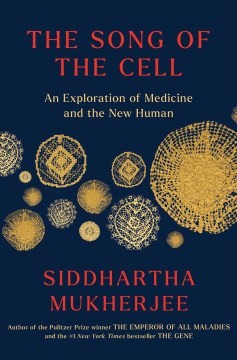
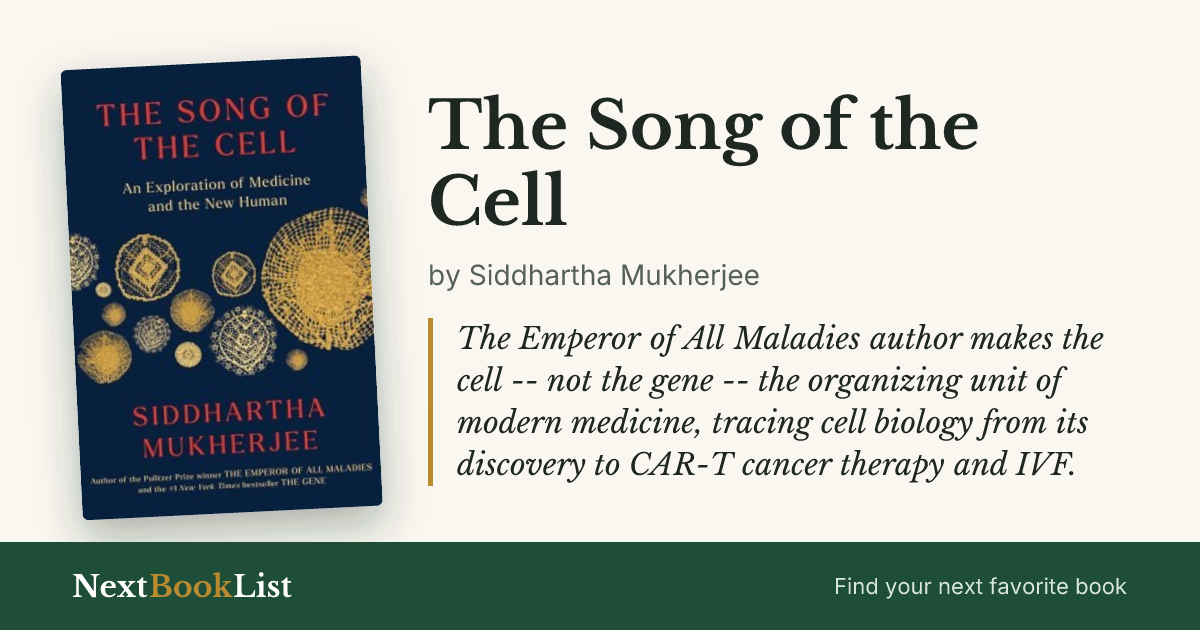
The Song of the Cell
by Siddhartha Mukherjee · 2022
The Emperor of All Maladies author makes the cell -- not the gene -- the organizing unit of modern medicine, tracing cell biology from its discovery to CAR-T cancer therapy and IVF.
Worth reading? Mukherjee's move here is to argue the cell, not the gene, deserves to be biology's central organizing unit for medicine going forward -- his previous books covered cancer genetics and heredity, and this one zooms out to cellular biology itself, tracing the history from the first microscope observations of cells through to cutting-edge therapies like CAR-T cell cancer treatment and IVF, where manipulating individual cells directly cures or creates. It's a genuinely ambitious synthesis, moving between historical narrative, hard biology, and bedside patient stories with the same rigor and clarity that made his cancer book work. It beats the average pop-science medicine book because Mukherjee is himself a practicing oncologist -- these aren't secondhand cases.
| Full Title | The Song of the Cell: An Exploration of Medicine and the New Human |
|---|---|
| Author | Siddhartha Mukherjee |
| Published | 2022 |
| Publisher | Scribner |
| Category | Science & Nature |
| Favorite quote | “The cell is the unit of life -- indivisible, capable of independent existence, and yet the fundamental building block of every organism, including us.” |
The Verdict
Mukherjee’s clinical background is what keeps this from reading like secondhand science journalism – when he describes what CAR-T therapy does to a patient’s own cells, he’s describing something he’s done, not something he read about. It’s a long, dense book, but it earns the length.
you want rigorous, narrative-driven science writing on how understanding individual cells is reshaping medicine, from cancer treatment to fertility
you want a quick primer -- this is a long, dense book that moves through history, biology, and clinical medicine in equal depth
Book Summary
Mukherjee argues the cell, not the gene, should be understood as the fundamental organizing unit of modern medicine, since it's at the level of the individual cell that health, disease, and increasingly treatment itself actually happen -- genes matter because of what they do inside cells, not in the abstract.
Cell-based therapies represent one of the most significant recent shifts in medicine: CAR-T cell therapy re-engineers a cancer patient's own immune cells to hunt and destroy tumor cells, representing a fundamentally different treatment paradigm than chemotherapy or even earlier gene therapies.
The history of cell biology is itself a story of steadily improving observation technology -- from the first microscopes revealing cells at all, to modern techniques allowing scientists to track, edit, and manipulate individual cells with precision that would have seemed like science fiction a generation ago.
IVF and reproductive medicine are, per Mukherjee's framing, also fundamentally cell-based interventions -- manipulating individual egg and sperm cells outside the body -- placing fertility treatment in the same conceptual lineage as cancer immunotherapy rather than as a separate medical specialty.
Top 8 Lessons from The Song of the Cell
- Mukherjee argues the cell, not the gene, should be biology's central organizing unit for modern medicine.
- CAR-T cell therapy re-engineers a cancer patient's own immune cells to target tumors, a fundamentally different paradigm than chemotherapy.
- The history of cell biology tracks closely with improvements in observation technology, from early microscopes to modern cell-tracking techniques.
- IVF and reproductive medicine are, in Mukherjee's framing, cell-based interventions in the same conceptual lineage as cancer immunotherapy.
- Genes matter clinically because of what they do inside specific cells, not as abstract instructions separate from cellular context.
- Mukherjee draws on his own practice as an oncologist, grounding the book's cell therapy sections in direct clinical experience.
- Manipulating individual cells directly -- rather than treating the whole organism -- is an increasingly central strategy across cancer treatment and fertility medicine.
- The book traces a throughline from the first cell observations under early microscopes to today's precision cell-editing technology.
Top 3 Quotes from The Song of the Cell
"The cell is the unit of life -- indivisible, capable of independent existence, and yet the fundamental building block of every organism, including us."
Siddhartha Mukherjee, The Song of the Cell
"A gene without a cell is lifeless -- an instruction manual stored inside an inert molecule, a musical score without a musician, a lonely library with no one to read the books within it. A cell brings materiality and physicality to a set of genes. A cell enlivens genes."
Siddhartha Mukherjee, The Song of the Cell
"Why, you might ask, do the medical mysteries of the Covid-19 pandemic sit at the center of a book on cell biology? Because cell biology sits at the center of the medical mysteries."
Siddhartha Mukherjee, The Song of the Cell
Frequently Asked Questions
Is The Song of the Cell worth reading?
Yes, if you want an ambitious, rigorously reported synthesis of cell biology and modern medicine from a practicing oncologist. It's long and dense, so it's a bigger commitment than a quick science primer.
What is The Song of the Cell about?
Siddhartha Mukherjee's case that the cell, not the gene, is the true organizing unit of medicine, tracing cell biology's history from early microscopy through to CAR-T cancer therapy and IVF.
How does The Song of the Cell relate to The Emperor of All Maladies?
It's a thematic follow-up -- Mukherjee's earlier books covered cancer and genetics specifically, while The Song of the Cell zooms out to cellular biology as the broader organizing framework behind both.
Is The Song of the Cell heavy on medical detail?
Yes -- it moves through history, biology, and clinical medicine in real depth, so it rewards readers willing to sit with dense material rather than skim for a quick takeaway.
Ready to read it?
Get The Song of the Cell on Amazon