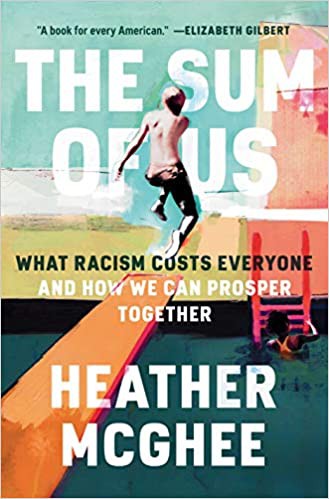
The Sum of Us
by Heather McGhee · 2021
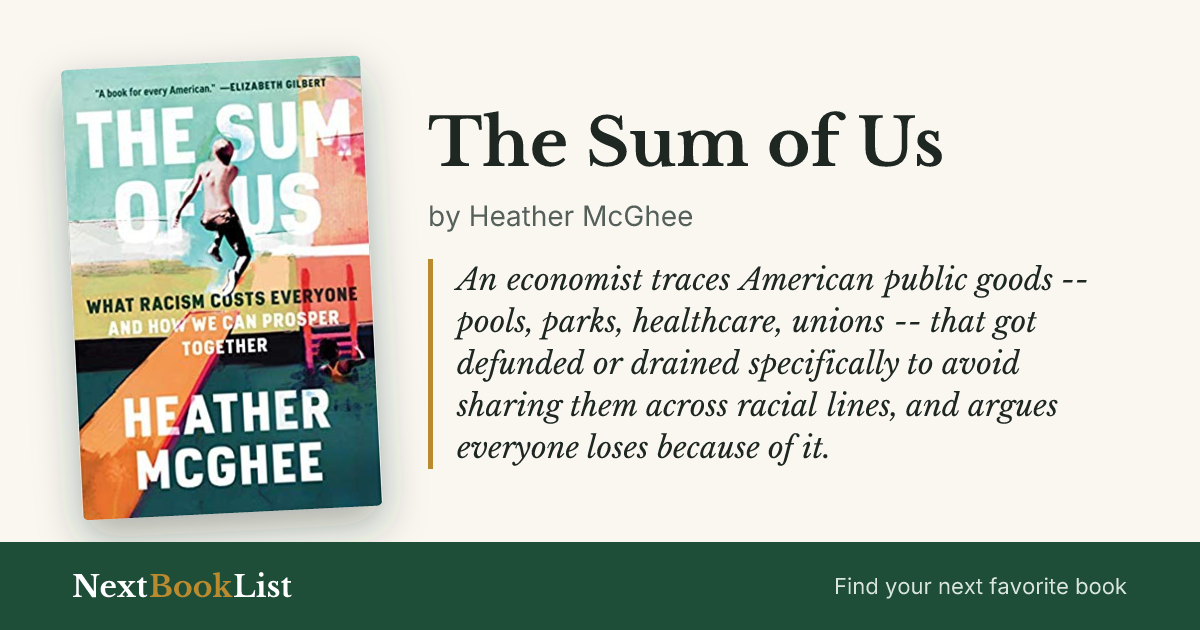
An economist traces American public goods -- pools, parks, healthcare, unions -- that got defunded or drained specifically to avoid sharing them across racial lines, and argues everyone loses because of it.
Worth reading? McGhee's organizing image -- literally draining public swimming pools across America rather than integrating them -- becomes the thesis for the whole book: a 'zero-sum' racial framing convinced white communities to destroy shared public goods rather than share them with Black Americans, and the result was that everyone, across racial lines, lost the pools, the parks, and often the tax-funded programs that went with them. She backs this with real economic data and field reporting, traveling to interview both the people harmed and the people who benefited from cross-racial solidarity movements, making the case that racism has a measurable 'solidarity dividend' cost to the whole economy, not a hypothetical one. It beats a purely moral argument for racial justice because McGhee builds toward a self-interested economic case that lands with readers a moral appeal alone might not reach.
| Full Title | The Sum of Us: What Racism Costs Everyone and How We Can Prosper Together |
|---|---|
| Author | Heather McGhee |
| Published | 2021 |
| Publisher | One World |
| Category | Sociology & Culture |
| Favorite quote | “Racism got in the way of all of us having nice things.” |
The Verdict
McGhee’s pool-draining image is the kind of detail that reframes an entire argument – once you’ve seen that pattern, the “zero-sum” thesis stops being abstract and starts explaining a lot of policy history you’d otherwise chalk up to something else. It’s an economic argument dressed as history, and it’s more persuasive for it.
you want a data-driven, reported argument for how racism produces material costs for everyone, not just its direct targets
you want a purely historical or purely personal-narrative account -- McGhee builds an economic and policy argument, using travel and interviews as evidence for that thesis
Book Summary
Many American communities literally drained and closed public swimming pools in the mid-20th century rather than integrate them, a pattern McGhee documents as emblematic of a broader "zero-sum" mindset: the belief that racial progress for Black Americans must come at white Americans' expense, which led communities to destroy shared public goods rather than share them.
This zero-sum framing produced measurable economic costs for white Americans too, not just for the Black Americans it was ostensibly targeting -- McGhee terms the potential gain from cross-racial solidarity the "solidarity dividend," and argues policies weakened by racial zero-sum thinking (unions, public healthcare expansion, homeownership programs) would have benefited working-class Americans of all races.
McGhee builds her case through direct field reporting -- traveling to interview both people harmed by these dynamics and communities that found cross-racial solidarity to reverse them -- combining economic data with narrative reporting rather than staying purely theoretical.
The book argues that racism functions, in part, as a tool used by those benefiting from economic inequality to prevent multiracial coalitions from forming around shared class interests, making cross-racial solidarity a genuine political and economic threat to that arrangement.
Top 7 Lessons from The Sum of Us
- Many American communities drained and closed public swimming pools rather than integrate them, destroying a shared public good instead of sharing it.
- McGhee's 'zero-sum' framing describes the belief that racial progress for Black Americans must cost white Americans, which has driven public goods destruction historically.
- The 'solidarity dividend' is McGhee's term for the economic gains available to all races from cross-racial coalition and shared public investment.
- Racial zero-sum thinking has historically weakened policies (unions, healthcare expansion, housing programs) that would have benefited working-class Americans across racial lines.
- Racism can function as a tool to prevent multiracial coalitions from forming around shared economic class interests.
- McGhee's case is built from direct field reporting and interviews, not purely from economic theory or historical narrative alone.
- The book argues racism produces material costs for the group it doesn't directly target, not just moral or social costs.
Top 3 Quotes from The Sum of Us
"Racism got in the way of all of us having nice things."
Heather McGhee, The Sum of Us
"Wanting someone to stand for the national anthem rather than stand up for justice means loving the symbol more than what it symbolizes."
Heather McGhee, The Sum of Us
"Instead of being blind to race, color blindness makes people blind to racism, unwilling to acknowledge where its effects have shaped opportunity or to use race-conscious solutions to address it."
Heather McGhee, The Sum of Us
Frequently Asked Questions
Is The Sum of Us worth reading?
Yes -- it's a data-driven, well-reported case for how racial zero-sum thinking produces material economic costs for everyone, not just the group it directly targets.
What is The Sum of Us about?
Heather McGhee's argument, built from economic data and field reporting, that American communities have repeatedly destroyed shared public goods (like swimming pools and unions) to avoid integrating them, at a real economic cost to everyone.
What is the 'solidarity dividend' in The Sum of Us?
McGhee's term for the economic gains available to people of all races from cross-racial coalition-building and shared public investment, as opposed to the losses from zero-sum racial thinking.
Is The Sum of Us a history book or an economics book?
Both -- it combines historical case studies (like the pool-draining pattern) with economic analysis and field reporting to build a contemporary policy argument.
Ready to read it?
Get The Sum of Us on Amazon