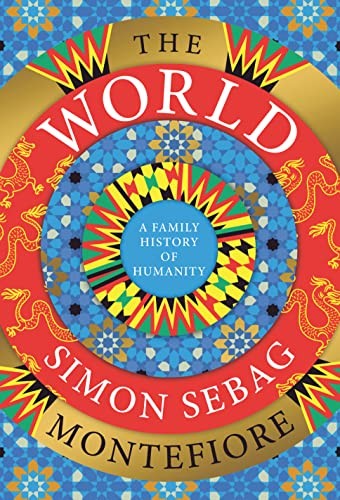
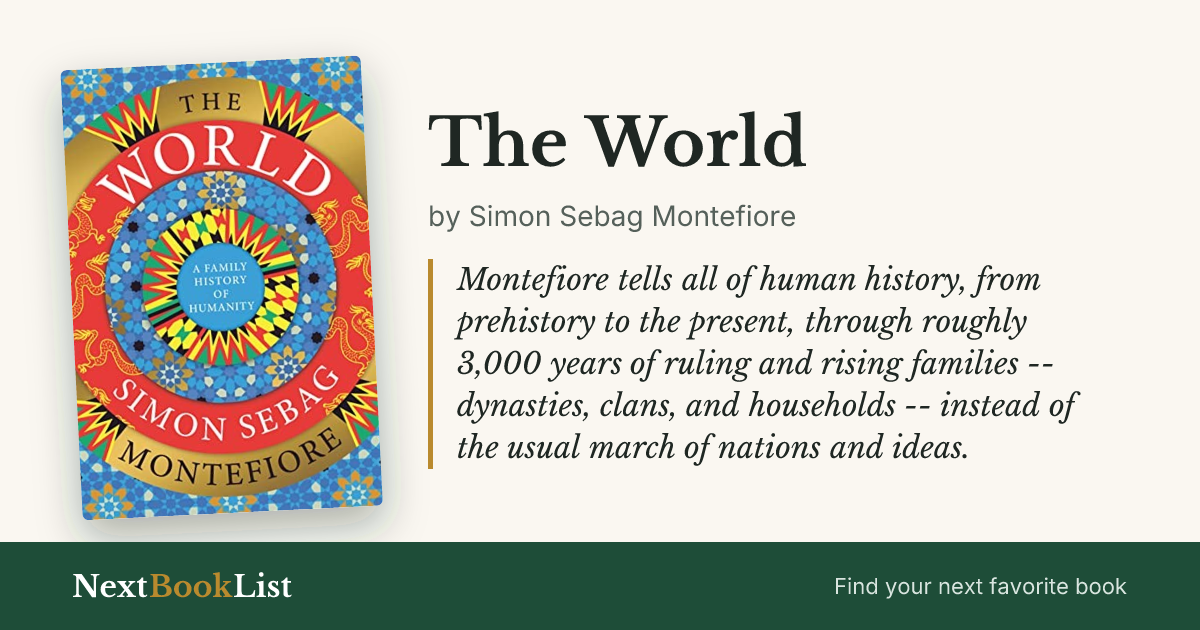
The World
by Simon Sebag Montefiore · 2022
Montefiore tells all of human history, from prehistory to the present, through roughly 3,000 years of ruling and rising families -- dynasties, clans, and households -- instead of the usual march of nations and ideas.
Worth reading? Montefiore's organizing trick -- families instead of nations or ideologies -- gives an otherwise impossibly vast subject a throughline you can actually follow, and it surfaces regions (Southeast Asia, Africa, pre-Columbian Americas) that a Western-centric world history usually shortchanges. The tradeoff is length: at over 1,300 pages, this is a project, not a weekend read.
| Full Title | The World: A Family History of Humanity |
|---|---|
| Author | Simon Sebag Montefiore |
| Published | 2022 |
| Publisher | Knopf |
| Category | History |
| Favorite quote | “The real problem of humanity is we have Palaeolithic emotions, medieval institutions and Godlike technology.” |
The Verdict
The family-as-organizing-principle trick is what makes 1,300 pages of world history actually readable instead of a reference brick you dip into. Montefiore threads ambition, marriage, and betrayal through millennia and continents, and it holds together better than a strict chronological survey would.
The scale is real, though. This isn’t a book you finish over a weekend, and it’s not meant to be. Read it in sections, by region or era, if the full sweep feels daunting – the structure supports that better than a straight cover-to-cover read for most people.
Read it if you want the closest thing to a genuinely global single-volume history, with real attention paid to regions most surveys shortchange. Skip it if you’re looking for a focused, tightly scoped history of one period – this book’s whole appeal is the opposite of narrow.
you want a genuinely global, single-volume world history and don't mind a 1,300-page commitment to get it
you want a tight, focused narrative on one era or region -- this is a sweeping, family-by-family survey across the entire span of human history, not a deep dive into any single period
Book Summary
Montefiore organizes the entire span of human history -- from prehistory through the 21st century -- around ruling families, dynasties, and households rather than nations, ideologies, or wars, arguing that family (marriage, inheritance, rivalry, betrayal) is the actual mechanism through which power has moved across nearly every civilization, more consistently than any other organizing principle.
The book deliberately balances its attention across regions that a typical Western-centric world history shortchanges -- African kingdoms, Southeast Asian empires, pre-Columbian American civilizations get real space alongside the more familiar European and Middle Eastern dynasties, making the book's claim to be a genuinely global history more than a marketing label.
Montefiore's own observation that "the real problem of humanity is we have Palaeolithic emotions, medieval institutions and Godlike technology" runs as an implicit thread through the whole book: however much technology and social structure change across the millennia, the same family dynamics -- ambition, jealousy, loyalty, betrayal -- keep recurring as the actual engine of historical change.
Top 8 Lessons from The World
- Family structures (marriage alliances, inheritance disputes, sibling rivalry) have been a more consistent driver of historical power shifts across civilizations than ideology or nationalism.
- A world history organized around families rather than nations can surface continuity across eras that a strictly chronological, nation-by-nation account would miss.
- Regions often shortchanged in standard world histories (African kingdoms, Southeast Asian empires, pre-Columbian civilizations) had power structures and dynastic complexity comparable to better-known European examples.
- Slavery and its role within family and household structures recurred across vastly different civilizations and eras, not as a uniquely regional or era-specific institution.
- Human institutions and technology have changed dramatically across millennia, but the underlying emotional drivers of power struggles (ambition, jealousy, betrayal) have changed comparatively little.
- Ambitious single-volume histories require organizing principles (here, family) strong enough to hold together an otherwise unmanageable amount of material.
- Dynastic succession crises recur as a specific, identifiable failure mode across empires that otherwise have little else in common.
- A truly global history requires deliberately correcting for the default weighting toward European and Middle Eastern source material that most Western historiography carries.
Top 2 Quotes from The World
"The real problem of humanity is we have Palaeolithic emotions, medieval institutions and Godlike technology."
Simon Sebag Montefiore, The World
"Human history is like one of those investment warning clauses: is no guarantee of future results."
Simon Sebag Montefiore, The World
Frequently Asked Questions
Is The World worth reading?
Yes, if you want a single-volume, genuinely global history of humanity and don't mind committing to over 1,300 pages -- the family-based organizing structure makes an otherwise unmanageable subject actually followable.
What is The World about?
Simon Sebag Montefiore's history of humanity from prehistory to the present, told through the ruling families, dynasties, and households that have driven power across nearly every civilization and region.
Is The World a quick read?
No -- it's over 1,300 pages. Treat it as a long-term project, not a book you'll finish in a week, and it rewards reading in sections rather than straight through.
Does the book cover non-Western history in real depth?
Yes -- it deliberately gives real space to African kingdoms, Southeast Asian empires, and pre-Columbian American civilizations, not just the more familiar European and Middle Eastern dynasties.
How is this different from a standard world history textbook?
It's organized around families and dynasties rather than nations, dates, or wars, which gives it more narrative momentum and continuity than a typical chronological survey, at the cost of being less exhaustively systematic.
Ready to read it?
Get The World on Amazon