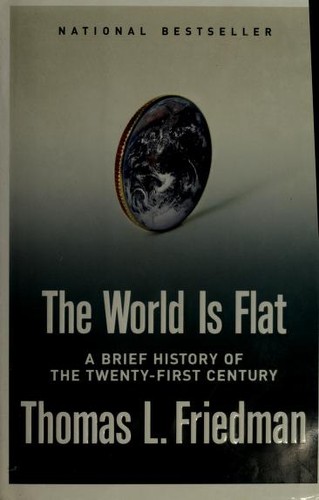
The World Is Flat
by Thomas Friedman · 2005
Friedman argues that the internet, outsourcing, and supply-chain software have leveled the global economic playing field -- and that individuals and companies who don't adapt to a flatter world will get run over by ones who do.
Worth reading? The World Is Flat is at its best as a snapshot of a specific hinge moment -- the mid-2000s convergence of broadband, outsourcing, and workflow software that let a radiologist in India read a scan taken in Ohio. It's weaker as prophecy; twenty years on, some of Friedman's confident extrapolations about a frictionless global economy look thinner than the reporting that produced them.
| Full Title | The World Is Flat: A Brief History of the Twenty-First Century |
|---|---|
| Author | Thomas Friedman |
| Published | 2005 |
| Publisher | Farrar, Straus and Giroux |
| Category | Business & Money |
The Verdict
Friedman is a reporter first, and the book is strongest when he’s just describing what he saw: a call center in India, a factory floor in China, the software that lets a radiologist review a scan from another continent. That’s the part that still holds up.
Where it wobbles is the extrapolation. Reading it now, the confident claim that a flattened world was mostly a settled, ongoing trend feels like a snapshot of 2005 optimism rather than a durable forecast – trade wars, reshoring pressure, and geopolitical friction complicated the story since.
Read it if you want a well-reported picture of how outsourcing and connectivity technology reshaped global business in the early 2000s. Skip it if you’re looking for a framework that still predicts 2020s globalization accurately – pair it with more recent reporting instead.
you want a big-picture framework for how globalization and connectivity technology reshaped work and competition in the early 2000s
you want a book that has aged gracefully -- large parts of the economic and geopolitical landscape Friedman describes have shifted enough that some predictions now read as dated or wrong
Book Summary
Friedman's central metaphor is that ten converging forces -- the fall of the Berlin Wall, the rise of the internet browser, workflow software, outsourcing, offshoring, supply-chaining, insourcing, in-forming, and the wireless "steroids" amplifying all of it -- flattened the global playing field, letting individuals and small companies compete globally in ways only large corporations and nations could before.
He builds the argument through reporting from call centers in Bangalore, software shops in China, and supply-chain hubs run by companies like Walmart and UPS, showing concretely how a task that once required physical proximity (reading an X-ray, writing code, staffing a help desk) could now be done anywhere with a broadband connection.
The book's second half turns to what this flattening means for American workers and students: Friedman argues the U.S. needs to double down on the "untouchable" jobs -- ones requiring adaptability, creativity, and specialization -- because routine, replicable work is the first to move to wherever it's cheapest.
Top 7 Lessons from The World Is Flat
- Broadband, workflow software, and open standards let tasks be broken apart and completed anywhere in the world, not just where a company's headquarters happens to be.
- Outsourcing and offshoring aren't the same thing -- outsourcing hands a function to another company, offshoring moves your own operations to another country -- and both accelerated together in the flattening Friedman describes.
- 'Untouchable' jobs, ones requiring specialized adaptability and creativity rather than routine, replicable tasks, are the ones most insulated from global competition.
- Supply-chain companies like Walmart didn't just move goods faster, they restructured entire industries around real-time inventory data shared across borders.
- A flatter playing field cuts both ways: individuals and small companies gain access to global markets, but they also face global competition they didn't face before.
- Friedman treats education and adaptability, not protectionism, as the right response to a flattening world -- a framing that shaped a lot of 2000s-era policy debate.
- The book's optimism about frictionless global integration underestimated how much geopolitics, trade friction, and populist backlash would push back against flattening in the following two decades.
Frequently Asked Questions
Is The World Is Flat worth reading?
It's worth reading as a historical document of the mid-2000s globalization moment, though you should read it alongside newer material -- some of its predictions haven't held up.
What does 'the world is flat' mean?
Friedman's metaphor for how technology and outsourcing let individuals and companies anywhere compete on a more level global playing field than before, instead of competition being dominated by geography and large institutions.
Has The World Is Flat aged well?
Unevenly -- the reporting on outsourcing and supply-chain technology holds up, but the broader optimism about frictionless global integration looks dated after two decades of trade conflict and deglobalization pressure.
Do I need a business background to read it?
No -- Friedman writes for a general audience and explains the technology and economics as the book goes.
Ready to read it?
Get The World Is Flat on Amazon