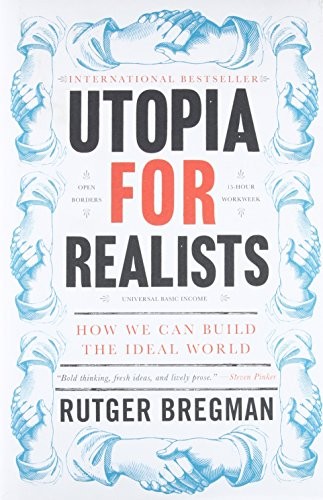
Utopia for Realists
by Rutger Bregman · 2017
A Dutch historian makes the case for universal basic income, a 15-hour workweek, and open borders, arguing that big utopian ideas -- not incremental policy tweaks -- are what actually move history forward.
Worth reading? Bregman's argument is that most political debate today happens inside a very narrow, technocratic box -- arguing over the size of a tax bracket rather than whether the whole system needs rethinking -- and that history's biggest gains (the abolition of slavery, the eight-hour workday, women's suffrage) all started as fringe utopian demands that sounded absurd right up until they didn't. He builds the case for universal basic income mostly around a real 1970s Canadian experiment (Mincome) and modern pilot studies, and he's persuasive on the historical pattern even where individual policy proposals are more provocation than blueprint. This is a book meant to widen what counts as a reasonable conversation, not to hand you a finished five-year plan -- read it that way and it works. Read it as a policy manual and you'll find yourself wanting more numbers than Bregman is interested in providing.
| Full Title | Utopia for Realists: How We Can Build the Ideal World |
|---|---|
| Author | Rutger Bregman |
| Published | 2017 |
| Publisher | Little, Brown and Company |
| Category | Sociology & Culture |
| Favorite quote | “Poverty is not a lack of character. It's a lack of cash.” |
The Verdict
Bregman writes like a journalist, not an economist, and that’s both the appeal and the limit. You come away energized about ideas you’d probably written off as fringe, and genuinely informed about the history behind them – but you also come away wanting a second, wonkier book that actually runs the numbers on what a national basic income would cost and how it’d be paid for. Bregman isn’t trying to write that book. He’s trying to convince you the conversation is worth having at all, and on that narrower goal, he succeeds.
Read it if you want your sense of what’s “politically realistic” widened with real historical grounding. Skip it if you need a detailed fiscal blueprint before you’ll take an idea seriously – this is the persuasion stage, not the implementation stage.
you want an optimistic, evidence-backed counterargument to the idea that radical policy change (a basic income, a shorter workweek) is naive or impossible
you're looking for a rigorous policy paper with detailed implementation plans -- Bregman is a popularizer and storyteller making the big-picture case, not an economist modeling second-order effects
Book Summary
Political imagination has narrowed to arguing over technocratic details (tax rates, regulatory tweaks) rather than fundamental structure, and that narrowing itself is a choice, not an inevitability -- past generations debated abolishing slavery and giving women the vote as live utopian proposals, not settled facts, and Bregman argues today's "unrealistic" ideas (basic income, a shorter workweek, open borders) deserve the same treatment rather than automatic dismissal.
Poverty is better understood as a lack of cash, not a lack of character, and giving people money directly (rather than in-kind aid or conditional programs) tends to outperform more paternalistic anti-poverty programs -- a claim Bregman grounds in the 1970s Mincome experiment in Dorothy, Manitoba, and later cash-transfer pilots, where recipients largely used unconditional money productively rather than squandering it, undercutting the assumption that the poor need supervision along with support.
Work itself, not just income, deserves scrutiny -- Bregman argues a large share of modern jobs are what he (following anthropologist David Graeber) calls socially unnecessary "bullshit jobs," and that a shorter standard workweek historically correlates with rising productivity rather than economic collapse, making a shorter workweek a realistic policy goal rather than a fantasy.
Top 8 Lessons from Utopia for Realists
- Ideas dismissed as politically 'unrealistic' today (basic income, open borders, a 15-hour workweek) often occupy the same rhetorical position abolition and women's suffrage once did before they became mainstream.
- The 1970s Mincome experiment in Dorothy, Manitoba gave residents unconditional cash and found people largely used it productively -- work hours dropped modestly and mainly among new mothers and teenagers finishing school, not able-bodied adults quitting jobs.
- Poverty functions like a cognitive tax -- financial scarcity itself consumes mental bandwidth, which helps explain why unconditional cash transfers often outperform conditional, supervised aid programs.
- A large share of modern white-collar work may be socially unnecessary 'bullshit jobs' that exist for organizational or status reasons rather than genuine productive value.
- Historically, reductions in the standard workweek have correlated with rising productivity, not economic decline, undercutting the assumption that working fewer hours must mean producing less.
- Major social reforms (abolishing slavery, the eight-hour workday, women's suffrage) were treated as fringe utopian fantasies right up until the moment they became conventional policy.
- Universal basic income removes the means-testing and supervision built into most welfare systems, which Bregman argues wastes resources on monitoring recipients rather than just giving them what they need.
- Narrowing political debate to technocratic tweaks (adjusting a tax bracket) rather than structural questions is itself a political choice that limits what reforms even get considered.
Top 5 Quotes from Utopia for Realists
"Poverty is not a lack of character. It's a lack of cash."
Rutger Bregman, Utopia for Realists
"Ideas, however outlandish, have changed the world, and they will again."
Rutger Bregman, Utopia for Realists
"The great milestones of civilization always have the whiff of utopia about them at first."
Rutger Bregman, Utopia for Realists
"You can't pull yourself up by your bootstraps if you have no boots."
Rutger Bregman, Utopia for Realists
"Free money works."
Rutger Bregman, Utopia for Realists
Frequently Asked Questions
Is Utopia for Realists worth reading?
Yes, if you want an optimistic, historically-grounded case for big policy ideas like universal basic income and a shorter workweek -- it's a popularizing argument for taking utopian proposals seriously, not a technical policy manual.
What is Utopia for Realists about?
Rutger Bregman argues political debate has narrowed to technocratic tweaks and makes the case for bigger ideas -- universal basic income, a 15-hour workweek, and open borders -- grounding the case in history and pilot studies like the 1970s Mincome experiment.
Does Utopia for Realists give a detailed plan for implementing universal basic income?
No. Bregman argues the historical and moral case for taking the idea seriously and cites pilot evidence, but he doesn't provide a detailed fiscal implementation plan -- that's a fair limitation to expect going in.
Is Utopia for Realists left-wing or right-wing?
Bregman frames the book around ideas rather than party lines -- basic income and open borders have supporters across the political spectrum -- but the overall tone and policy proposals lean progressive.
What is the Mincome experiment mentioned in Utopia for Realists?
Mincome was a 1970s Canadian guaranteed-income pilot in Dorothy, Manitoba, that gave residents unconditional cash payments. Bregman cites it as evidence that recipients largely used the money productively rather than abandoning work.
Ready to read it?
Get Utopia for Realists on Amazon