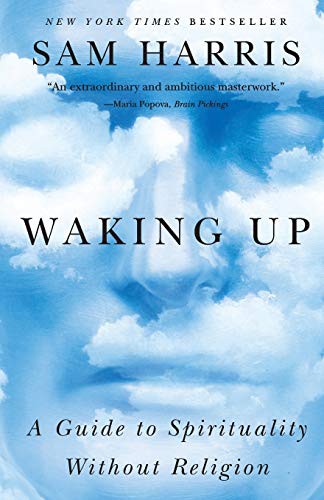
Waking Up
by Sam Harris · 2014
A neuroscientist and outspoken atheist makes the case that spiritual experience is real, testable, and worth pursuing anyway.
Worth reading? Waking Up is the rare spirituality book written by someone whose day job is arguing against religion. Harris, a neuroscientist and one of the New Atheist movement's most prominent voices, spends the book making an unusually careful case that the self is, under scrutiny, an illusion, and that meditation is the most reliable tool for actually seeing that directly rather than just being told it. He strips away every trace of religious framing and rebuilds the case from philosophy of mind and his own practice. It reads more like an argument than a guide, dense in places, but it's the best entry point for a reader who trusts rigor over vibes.
| Full Title | Waking Up: A Guide to Spirituality Without Religion |
|---|---|
| Author | Sam Harris |
| Published | 2014 |
| Publisher | Simon & Schuster |
| Category | Religion & Spirituality |
| Favorite quote | “The feeling that we call 'I' is an illusion.” |
The Verdict
Harris is arguing against his own instincts here, or at least against how his audience expects him to argue – he’s spent years dismantling religious claims, and then turns around to make a serious case for the reality of spiritual experience. The trick is he never asks you to believe anything supernatural to get there. The self dissolving under close inspection is presented as a claim you can test yourself, not a doctrine you take on faith.
It reads dense in places, closer to a philosophy essay than a warm guide, because that’s the audience Harris is writing for: people who’d tune out anything that sounded devotional. Read it if you want the case for meditation built from first principles instead of tradition. Skip it if you want a gentler, more devotional tone – this isn’t that book.
you're an atheist or skeptic who dismisses meditation as new-age nonsense but trusts a rigorous argument
you want warmth and devotional language -- Harris writes like a philosopher building a case, not a guide comforting you
Book Summary
The feeling of being a separate self, a little narrator living behind your eyes, doesn't hold up under close inspection. Harris argues this isn't mysticism, it's a claim about the actual architecture of consciousness that meditation lets you verify directly rather than take on faith.
Meditation, particularly the noticing of consciousness itself rather than its contents, is presented as a rigorous, teachable method, not a religious ritual. Harris is explicit that you can strip every metaphysical claim out of Buddhism and still be left with a genuinely useful technology of mind.
Spiritual experience and rational skepticism are not opposites. Harris's whole project is proving you can have the deepest experiences religious traditions describe, insight, self-transcendence, a end to the felt sense of separation, without accepting any of the supernatural claims that usually come bundled with them.
Top 8 Lessons from Waking Up
- The felt sense of being a separate self behind your eyes doesn't hold up once you look at it directly.
- Meditation is presented as a testable method for examining consciousness, not a religious ritual requiring belief.
- You can extract Buddhism's practical insights while rejecting its metaphysical and supernatural claims entirely.
- Noticing consciousness itself, not just its contents, is the specific skill Harris says most meditation instruction skips.
- Psychedelics get serious treatment as one legitimate (if riskier) route to the same insight meditation aims for.
- Certainty about there being no self is treated as just as unearned as certainty that there is one -- investigate, don't assume.
- A rigorous, skeptical mind is not a disqualification for spiritual experience -- it's an asset.
- Most people mistake the self for something solid because they've never looked closely enough to notice otherwise.
Top 5 Quotes from Waking Up
"The feeling that we call 'I' is an illusion."
Sam Harris, Waking Up
"Spirituality must be distinguished from religion."
Sam Harris, Waking Up
"Our minds are all we have. They are all we have ever had. And they are all we can offer others."
Sam Harris, Waking Up
"How we pay attention to the present moment largely determines the character of our experience and, therefore, the quality of our lives."
Sam Harris, Waking Up
"Happily, the benefits of training in meditation arrive long before mastery does."
Sam Harris, Waking Up
Frequently Asked Questions
Is Waking Up worth reading?
Yes, especially if you're skeptical of religion and meditation but respect a rigorous argument -- Harris builds the case from philosophy of mind and neuroscience, not belief.
Is Waking Up a religious book?
No. Harris is an outspoken atheist and explicitly strips out religious framing, arguing spiritual experience and rational skepticism aren't opposites.
What is the main idea of Waking Up?
The sense of being a separate self is an illusion under close inspection, and meditation is the most reliable tool for seeing that directly rather than taking it on faith.
Does Waking Up teach you how to meditate?
Yes, it includes practical instruction, though the book is more argument-heavy and philosophical than a typical step-by-step meditation guide.
Who should read Waking Up?
Skeptics and atheists who've dismissed meditation as new-age nonsense but who respond to a carefully built, evidence-minded case.
Ready to read it?
Get Waking Up on Amazon