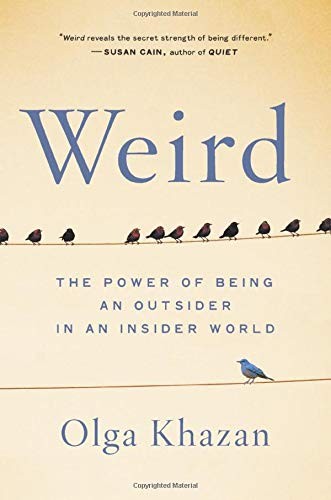
Weird
by Olga Khazan · 2020
An Atlantic staff writer, drawing on her own experience as an Armenian immigrant kid in small-town Texas and years of behavioral-science reporting, argues that whatever makes you an outsider -- race, neurodivergence, sexuality, plain personality -- can become a genuine advantage rather than just a wound.
Worth reading? Khazan's argument is that outsider status, whether it comes from ethnicity, immigration, neurodivergence, sexuality, or just an unusual personality, isn't only a liability to survive. Drawing on interviews with psychologists, her own childhood as one of the only Armenian kids in a small Texas town, and profiles of people who turned their outsider status into an asset (creative innovators, contrarian thinkers, successful founders), she builds the case that difference can sharpen creativity, resilience, and independent judgment, provided the outsider finds or builds a community where the difference isn't a constant tax. It's a well-reported, honestly personal book, more magazine-feature-collection than tightly argued thesis, but it earns its optimism instead of assuming it.
| Full Title | Weird: The Power of Being an Outsider in an Insider World |
|---|---|
| Author | Olga Khazan |
| Published | 2020 |
| Publisher | Hachette Go |
| Category | Sociology & Culture |
| Favorite quote | “But the kinds of stories you tell yourself matter. There are narratives about yourself in which your life can still get better, and there are those in which it will keep getting worse.” |
The Verdict
Khazan’s pitch lands somewhere between memoir and reported argument: the thing that made you feel like the odd one out, whatever it was, isn’t just a wound to manage. It can become a real asset, but only under specific conditions, and she’s honest enough to name the conditions instead of just handing you a feel-good platitude.
The personal thread, growing up as one of the only Armenian kids in a small conservative Texas town, gives the book its texture and its credibility. She’s not writing from theory. She’s writing from the actual discomfort of not fitting the room, and then going out and reporting whether that discomfort has a documented upside.
The honest finding, and the part that separates this from lazier “embrace your weirdness” books, is the caveat: outsider status only tends to become an advantage when it’s paired with at least one real community. Isolation without that community just produces worse outcomes, full stop. That’s a more useful and more true claim than the inspirational-poster version of this idea.
Read it if you’ve spent real years feeling like you don’t belong somewhere, at work, in your family, in your culture, and want something that takes that seriously without either wallowing in it or falsely inflating it into secret superpower status.
Skip it if you want tight, rigorous behavioral science. This is magazine-style reporting stitched into a book, strong on individual stories and honest reflection, looser on the kind of controlled evidence that would let you treat every claim as settled. Read it for the reframe and the company, not for a research thesis you’d cite in a paper.
you've spent your life feeling like the odd one out somewhere -- at work, in your family, in your culture -- and want a research-backed reframe instead of pure comfort-reading
you want a rigorous academic text -- this is journalism, built from interviews and behavioral-science reporting rather than original research, and it leans toward memoir-adjacent narrative in long stretches
Book Summary
Khazan argues that being an outsider (by ethnicity, neurodivergence, sexuality, immigration status, or plain personality mismatch with your surroundings) carries real psychological costs, but that the same difference that isolates someone can also become the seed of unusual creativity, resilience, and independent thinking, if the person survives the isolation long enough to develop those traits.
She draws heavily on her own childhood as one of few Armenian immigrant kids in a conservative small Texas town, using it as a throughline connecting the book's reported case studies, and arguing that the specific discomfort of not fitting in taught her to observe social dynamics more carefully than an insider would.
A recurring finding across her interviews and cited research is that outsider status becomes a genuine advantage mainly when paired with at least one supportive community or relationship, without which prolonged isolation just produces stress and worse mental health outcomes rather than resilience.
The book profiles specific "successful outsiders" (from business, science, and the arts) to argue that a degree of psychological distance from mainstream norms is common among unusually original thinkers, while being careful to note this is a correlation worth exploring, not a guarantee that being different automatically makes you exceptional.
Top 7 Lessons from Weird
- Outsider status by itself is a psychological cost, not automatically a superpower -- the advantage only tends to show up when paired with at least one real support system.
- Prolonged social isolation without a compensating community produces worse mental health outcomes, not resilience -- resilience research doesn't support 'suffering alone builds character' as a general rule.
- Observing a social environment from outside its norms (as an immigrant, a neurodivergent person, or a minority) can sharpen pattern recognition and creativity that insiders, who take the norms for granted, tend to miss.
- A meaningful share of unusually original thinkers across business, science, and the arts report some degree of outsider status or psychological distance from mainstream norms in their formative years.
- Reframing 'not fitting in' as data about the environment, rather than a personal deficiency, is itself a coping strategy with research behind it, not just positive thinking.
- Finding even one genuine community of similarly different people meaningfully changes outsider status from a liability into a source of identity and strength.
- The specific type of outsider status (race, neurodivergence, sexuality, immigration) changes the texture of the experience, but the underlying psychological mechanisms -- isolation risk, creativity upside, need for community -- recur across all of them.
Top 1 Quotes from Weird
"But the kinds of stories you tell yourself matter. There are narratives about yourself in which your life can still get better, and there are those in which it will keep getting worse."
Olga Khazan, Weird
Frequently Asked Questions
Is Weird by Olga Khazan worth reading?
Yes, if you've ever felt like the outsider somewhere and want a research-informed reframe rather than pure comfort. It's reported journalism with a personal throughline, not an academic study, so read it for the case studies and the honest personal writing, not for rigorous original data.
What is the main argument of Weird?
That outsider status, from race, neurodivergence, sexuality, immigration, or personality, carries real psychological cost but can also become a genuine source of creativity and resilience, mainly when the outsider finds at least one supportive community.
Is Weird a memoir or a research book?
Both, loosely. Khazan weaves her own experience as an Armenian immigrant kid in small-town Texas through reported interviews with psychologists and profiles of other outsiders, so it reads more like connected long-form journalism than a strict research book.
Does Weird romanticize being an outsider?
Mostly not -- Khazan is careful to note that isolation without community produces worse outcomes, not resilience, so the book's optimism is conditional rather than a blanket 'being different makes you special' message.
Ready to read it?
Get Weird on Amazon