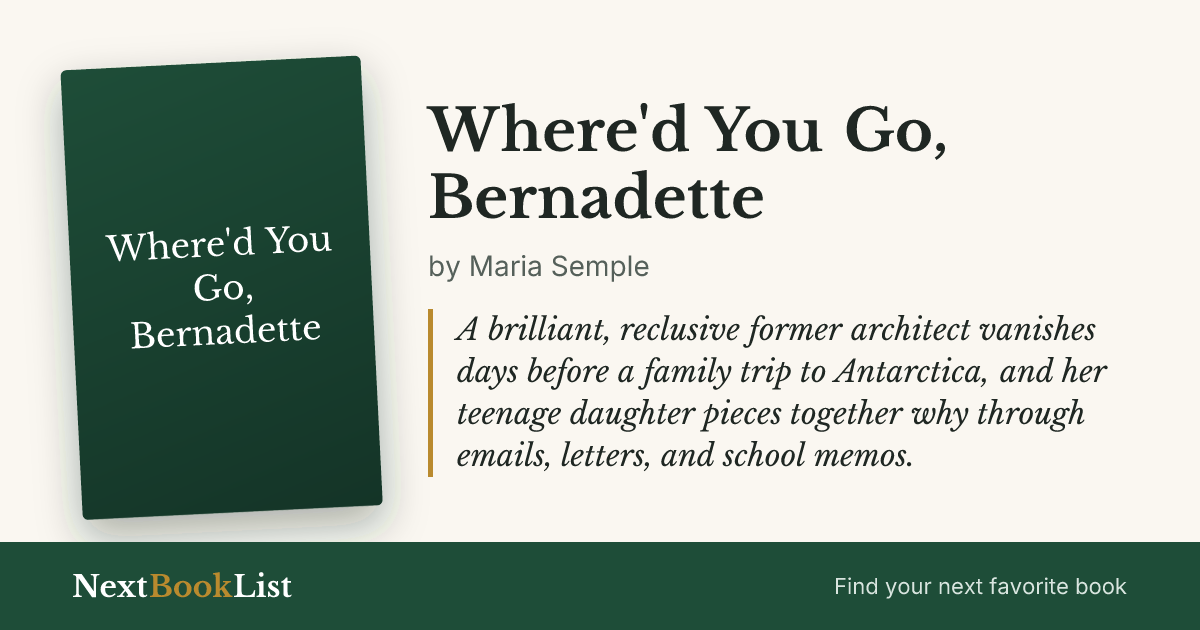
Where'd You Go, Bernadette
by Maria Semple · 2012
A brilliant, reclusive former architect vanishes days before a family trip to Antarctica, and her teenage daughter pieces together why through emails, letters, and school memos.
Worth reading? Semple's format is the reason this works: assembling the story from documents lets her satirize private-school parent culture and tech-spouse Seattle with real precision, while the mystery of Bernadette's disappearance gives the book forward momentum a straight comic novel of manners usually lacks.
| Author | Maria Semple |
|---|---|
| Published | 2012 |
| Publisher | Little, Brown and Company |
| Category | Fiction |
The Verdict
The document format is the whole engine of the comedy – watching competing, contradictory accounts of Bernadette pile up from different narrators (a furious neighbor, a school administrator, Bernadette herself) does more character work than straight narration would.
Semple’s satire of Seattle’s private-school parent culture is specific enough to sting, and specific enough to be funny rather than just snide. It’s clearly written by someone who’s sat through those meetings.
Where the book earns its emotional weight is in treating Bernadette’s collapse as genuine creative grief rather than just quirky dysfunction – the Antarctica ending recasts her disappearance as reclaiming agency, not running away.
Read it if you want sharp satire with real heart, delivered in an inventive format. Skip it if you’d rather have a conventional narrative instead of assembling the story from documents yourself.
you want a genuinely funny satire of Seattle tech-parent culture told through a clever documentary format, with a real emotional story about creative burnout underneath the jokes
you want a straightforward narrative -- the epistolary structure (emails, memos, letters) takes some adjusting to and isn't for readers who want continuous prose
Book Summary
Bernadette Fox was once a celebrated MacArthur-genius architect who dropped out of the profession after a professional disaster, and now lives as a reclusive, agoraphobic wreck in Seattle, hiring a virtual assistant in India to handle her life while she avoids the private-school parents she despises. Her daughter Bee narrates the book by assembling emails, memos, letters, and FBI documents to figure out what happened to her mother after Bernadette disappears just before a planned family trip to Antarctica.
Semple uses the documentary structure to satirize a specific slice of Seattle culture -- Microsoft-money tech spouses, competitive private-school parenting, performative environmentalism -- with a precision that reads as insider knowledge rather than easy mockery. The satire is sharp, but it's aimed at systems and social performance, not really at Bernadette herself.
Underneath the comedy is a real story about creative burnout: Bernadette isn't just eccentric, she's someone who built something extraordinary once, lost it, and has been quietly falling apart in the aftermath while everyone around her mistakes her withdrawal for mere rudeness or mental illness rather than grief for the work she can't do anymore.
Top 8 Lessons from Where'd You Go, Bernadette
- The novel is told entirely through assembled documents (emails, school memos, letters, FBI reports) narrated by Bee, which lets Semple show contradictory versions of Bernadette from different characters' points of view.
- Bernadette's outsourcing of her entire life to a virtual assistant in India is played for comedy but also shows how far she's withdrawn from functioning in her own daily life.
- The satire targets a specific culture -- competitive private-school parenting and tech-money Seattle -- with enough specificity that it reads as observed rather than generic mockery.
- Bernadette's backstory as a celebrated architect who abandoned the field after a professional betrayal reframes her present-day eccentricity as unprocessed creative grief, not just personality.
- Audrey Griffin, Bernadette's chief antagonist among the school parents, is eventually given enough of her own interiority that the satire doesn't flatten her into a pure villain.
- Bee's detective work in piecing together her mother's disappearance mirrors the reader's own experience of assembling Bernadette's character from fragments -- the structure and the plot reinforce each other.
- The book takes creative work seriously as a real human need -- Bernadette's collapse isn't cured by family love alone, it requires her getting back to making something.
- The eventual reveal of where Bernadette actually went (Antarctica, alone, ahead of her family) turns the disappearance from a tragedy into an act of reclaiming agency.
Frequently Asked Questions
Is Where'd You Go, Bernadette worth reading?
Yes -- it's a sharp, funny satire with a real emotional core about creative burnout, told through an inventive documentary format.
What is Where'd You Go, Bernadette about?
A reclusive former architect, Bernadette Fox, disappears days before a family trip to Antarctica, and her teenage daughter pieces together why through assembled emails, letters, and school documents.
Is Where'd You Go, Bernadette a comedy?
Mostly, yes -- it's a satire of Seattle private-school and tech-parent culture, though it has a genuinely emotional story about burnout underneath the humor.
Is the book told in a normal narrative format?
No -- it's epistolary, assembled from emails, memos, letters, and documents narrated around by Bee, which takes some adjustment if you prefer continuous prose.
Is the movie adaptation faithful to the book?
The 2019 film starring Cate Blanchett simplifies the documentary structure into a more conventional narrative, losing some of the book's satirical bite.
Ready to read it?
Get Where'd You Go, Bernadette on Amazon